
The Tow from Vats to Stord

New Year’s at the turn of 1988/89 came second for those involved in the tow of the Gullfaks C substructure from northern Rogaland to Sunnhordland. For the first time, a concrete platform substructure was to be towed on the open sea in winter.
Hauling what was then the heaviest structure ever taken offshore was no trivial task. The completed concrete GBS—with base section, cells, shaft and mechanical outfitting—was to set out on a four-day, 145 nautical miles (nm) passage. Forecasts initially looked grim, but conditions improved, and the tow could start late on the evening of December 30, 1988, only a few hours behind schedule.
A challenge was that the gigantic structure had to head out on the open sea off Karmøy and Bømlo before finding more sheltered waters and anchoring just south of Stord.
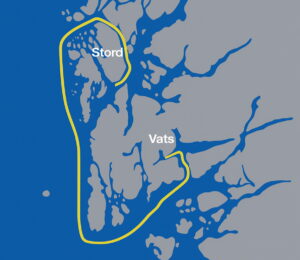
If winds strengthened beyond near-gale, the substructure had to be anchored. Contingency anchorages were therefore planned in advance where the installation could take shelter if needed.
Nine tugboats with combined engine power exceeding 100,000 horsepower (hp) provided the tow. Progress was slow: average speed was 1.8 knots— walking pace.[REMOVE]Fotnote: For information on the tow-out, see: Nedrebø, Rune (31 December 1988). “Gullfaks C Heading for Stord. The colossus left Yrkjesfjorden last night.” In: Stavanger Aftenblad, 31 December 1988, p. 5.
During the tow, the substructure extended 80 meters below the sea surface. It arrived safely in Digernessundet by Stord, where the next step was to prepare for mating with the topside.
Production start at Gullfaks BThe C deck and substructure meet