
The shuttle tankers

Throughout the history of the Gullfaks field, the shuttle tankers have been just as important as the platforms. Without shuttle tankers to transport the oil away, the platforms would have to shut down production.
In shuttle traffic
One disadvantage of this “milk-run” style of operation is the short sailing time. The frequent loading and unloading situations make the workday more hectic and fragmented than when one is at sea for several weeks at a time.
This was explained by the crew on board the shuttle tanker “M/T Ragnhild Knutsen” in March 1992 to the newspaper Strilen. The journalist joined the shuttle tankers out to the Gullfaks field to collect oil. The oil was to be transported to the Mongstad oil terminal.[REMOVE]Fotnote: Alver, Inge A. «I skytteltrafikk mellom oljefelta og Mongstad.» Strilen. March 18, 1992, 2-3.
At that time, Ragnhild Knutsen was one of nine shuttle tankers regularly transporting oil from the Gullfaks and Statfjord fields.
The vessel was under long-term charter, meaning that the crew and the vessel belonged to a shipping company — in this case Knutsen OAS — but that it sailed permanently for the Gullfaks and Statfjord licence groups.
Take a closer look at a model of the shuttle tanker “Juanita”.
The vessel was purpose-built to load oil from a loading buoy. Among other things, this meant that in the bow there was a specially built “bow house”, characteristic of shuttle tankers. The crew referred to it as “the house on the prairie”.
In this house the captain and the officer on watch sat during loading. From there it was easy to manoeuvre the vessel as close to the loading buoy as possible and to keep an eye on the weather. Even though the loading itself was controlled by a computer, it was the crew who had to assess whether the wave height was safe for loading. They also had to be able to override the system if needed.
This extra wheelhouse was one of many requirements Statoil set for its shuttle tankers.[REMOVE]Fotnote: Lindøe, John Ove. From sea to shore : the shuttle tanker story. Stavanger: Wigestrand Forlag and Stavanger Sjøfartsmuseum, 2009. 87-88.
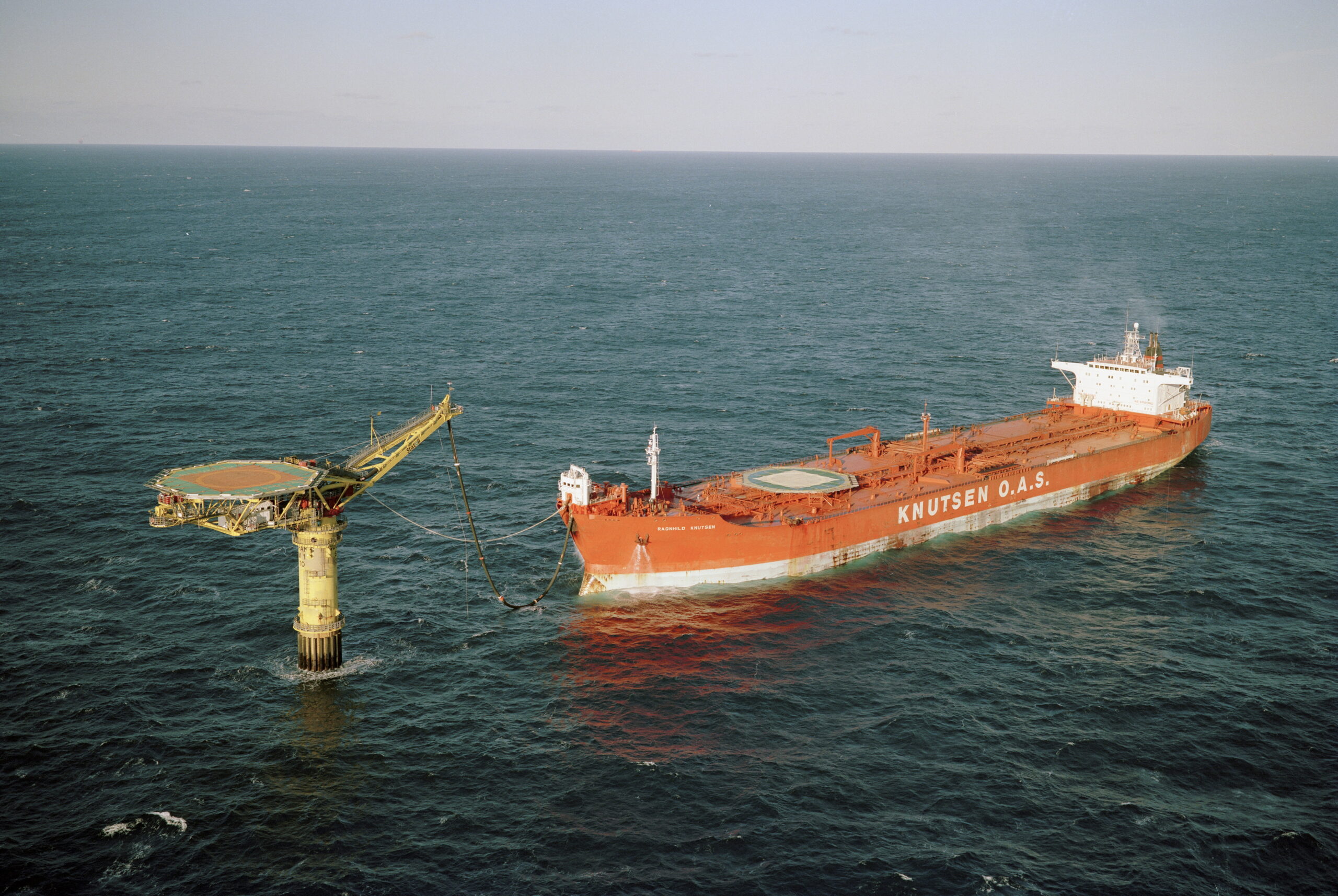
Two years after Strilen joined Ragnhild Knutsen at sea, the field reached a production record. On 7 October 1994 a record-high 605,965 barrels of oil were produced. During the period of high production on both the Gullfaks and Statfjord fields, the shuttle tankers went no farther than to the oil terminal at Mongstad or to a refinery around the North Sea — such as the refinery at Mongstad or the refinery at Kalundborg in Denmark — both operated by Statoil.
From the crude oil terminal at Mongstad, the oil was collected by conventional tankers embarking on longer voyages. Some of the Gullfaks oil was purchased by British Petroleum BP, and much was also sold to Asia.[REMOVE]Fotnote: Lise Gro Ekholdt, in conversation with researcher Ole Kvadsheim, February 28 2025.
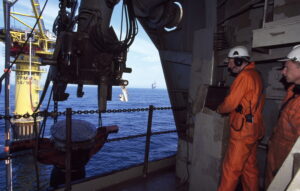
As we see in the article from Strilen, the crew on M/T Ragnhild Knutsen envied the crews on the conventional tankers because they more rarely had to “hook up” the vessel for loading and unloading. On the other hand, the shuttle tanker crews appreciated that they called at shore more often — which made it easier to stay in touch with family and to obtain necessary equipment and supplies.
Less frequent loading and unloading
Today, with lower production on the Gullfaks field, the Gullfaks platforms no longer need to offload oil as often. Consequently, it is now rare for Gullfaks oil to be stored temporarily at the Mongstad oil terminal. The shuttle tankers now more often carry their cargo directly to the customer, which means fewer loading and unloading operations for the crew.
As of 2025, much of the oil was sold to the Swedish Preem refineries on the west coast of Sweden.[REMOVE]Fotnote: Lise Gro Ekholdt, in conversation with researcher Ole Kvadsheim, February 28 2025.