
The NPD’s Improved Oil Recovery Award

Any major oil exploration area goes through different phases. Often there is an early phase with large discoveries and, in time, high production based on these. To varying degrees, depending among other things on the level of technology and the oil price, a need will eventually emerge to exploit the less accessible parts of the large reservoirs. In addition, it becomes important to find new and smaller
reservoirs in the same area.
In 1998 the Norwegian Petroleum Directorate established the IOR prize to recognise this type of activity. The Directorate describes the prize as “an award for creativity, perseverance, and willingness to take risks when it comes to applying methods and technology which can increase oil and gas recovery beyond what can be expected with existing plans and methods.”[REMOVE]Fotnote: https://www.npd.no/fakta/produksjon/ior/ior-prisen/
The first prize went to Norsk Hydro for innovative horizontal drilling on the Troll field. The method has made a major contribution to increasing recovery from thin oil zones and to maximising recovery of both gas and oil. This is one of the best-known examples of the Norwegian Petroleum Directorate’s role as a steward of society’s petroleum resources.[REMOVE]Fotnote: See, for example, https://equinor.industriminne.no/operatorkampen-om-troll/
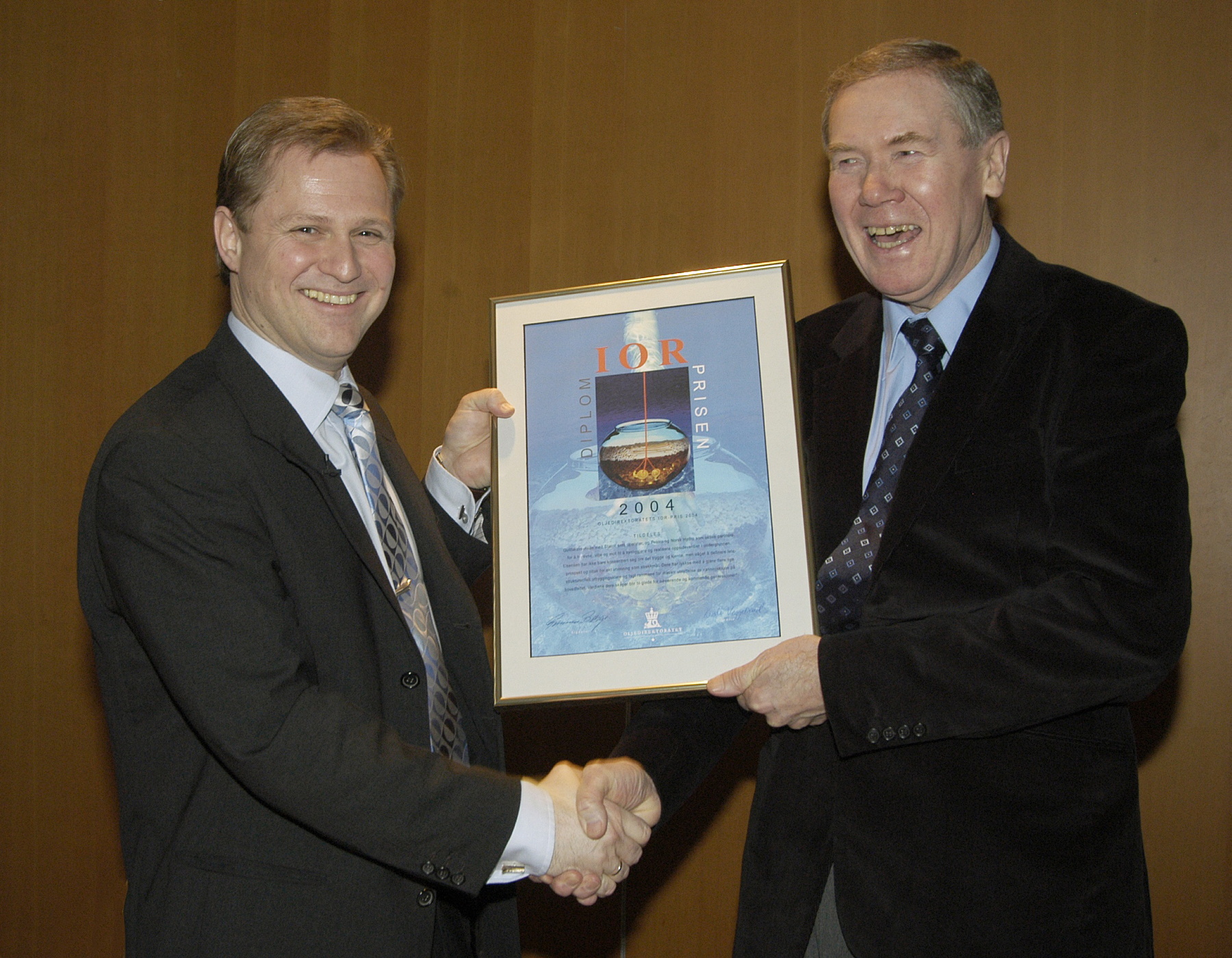
The award ceremony
At the Technology Conference in Stavanger in January 2005, the Gullfaks licence received the IOR prize. Together with Hydro and Petoro, Statoil was awarded the prize for achieving increased recovery from the field, among other things through the use of new drilling technology.[REMOVE]Fotnote: See film of the award ceremony here (episode 6, 06:00–07:40). Accepting the prize on behalf of the licence, Gullfaks production director Lars Chr. Bacher expressed hopes for a long remaining field life: “We have increased recoverable oil reserves from the main field from 1.3 billion barrels of oil in 1986 to 2.2 billion barrels today. Our ambition is to increase reserves further to more than 2.5 billion barrels of oil.”[REMOVE]Fotnote: https://www.equinor.com/no/news/archive/2005/01/27/PrestigePrizeForGullfaks
One example of the results of this type of drilling activity from Gullfaks C was the discovery of Topas, which later received the name Gimle. This discovery was widely covered in the documentary series Oljeriket, broadcast on NRK in 2006.[REMOVE]Fotnote: For more on the series, see the article “Oljeriket,” the TV series about life on the field. Approximate timestamps for when the Topas discovery is covered: Episode 3 (Geologists, Sandsli): 06:30–08:30, 11:40–13:00, 16:20–19:00 (discovery!), 21:50–23:00, 26:50–28:00. Episode 4 (Drill floor, Gullfaks C): 07:20–09:05 (over 5,000 meters of pipe pulled to recover the core), 15:00–16:50, 18:00–19:50 (geologists on the drill floor), 22:50–25:00 (“it smells of hydrocarbons”). Source: https://tv.nrk.no/serie/oljeriket
Statoil / Equinor has received the IOR prize several times, both alone and together with other companies.[REMOVE]Fotnote: See https://www.npd.no/fakta/produksjon/ior/ior-prisen/ Most recently this happened in 2022, when the company, together with the other licensees in the Statfjord field, received the prize for having extended the field’s lifetime by almost 40 years.[REMOVE]Fotnote: See https://www.npd.no/aktuelt/nyheter/generelle-nyheter/2022/far-ior-prisen-for-systematisk-arbeid-over-lang-tid/
Gullfaks from the SDFI to Statoil and Petoro“Oil Kingdom” — The TV Series About Life on Gullfaks C