
The Journey of Gullfaks Gas

Statpipe, the gas pipeline system connecting the Tampen area to the Kårstø processing plant, was brought online on 25 July 1985 — nearly two years before Gullfaks began producing gas. This means the export and processing infrastructure for Gullfaks gas was already in place well before Gullfaks A was installed. While Statfjord had spent years reinjecting gas into the reservoir due to lack of transport options, Gullfaks was able to sell its gas on the market from day one.
Until Gullfaks began production, Statfjord had been the only field using the Statpipe system — which runs from the Tampen area in the northern North Sea, through the Norwegian Trench, to Kårstø in Rogaland.[REMOVE]Fotnote: Note that Heimdal was connected to Statpipe as early as 1985, but delivered dry gas into the pipeline after it had passed through Kårstø.
Gas exported from Gullfaks is mixed with Statfjord gas in the Statpipe pipeline on its route to Kårstø. As a result, it’s not meaningful to track Gullfaks gas as a distinct stream or trace its destination, the way one might do with crude oil shipped by tanker. Still, we can describe the broader journey the combined gas stream takes once it enters Statpipe.
Processing at Kårstø
Gullfaks gas is transported via Statpipe to the Kårstø processing plant in Rogaland. When Kårstø came online in 1985, it only received gas from Statpipe. Since then, the pipeline system and the Kårstø facility have been expanded several times.
The figure below shows the construction years for various parts of the plant. On the intake side, the Sleipner line (1993) transports unstabilised condensate, while Åsgard Transport (2000) — which extends north to the Norwegian Sea — carries rich gas, just like Statpipe. The capacity of the Åsgard pipeline is nearly three times that of Statpipe.
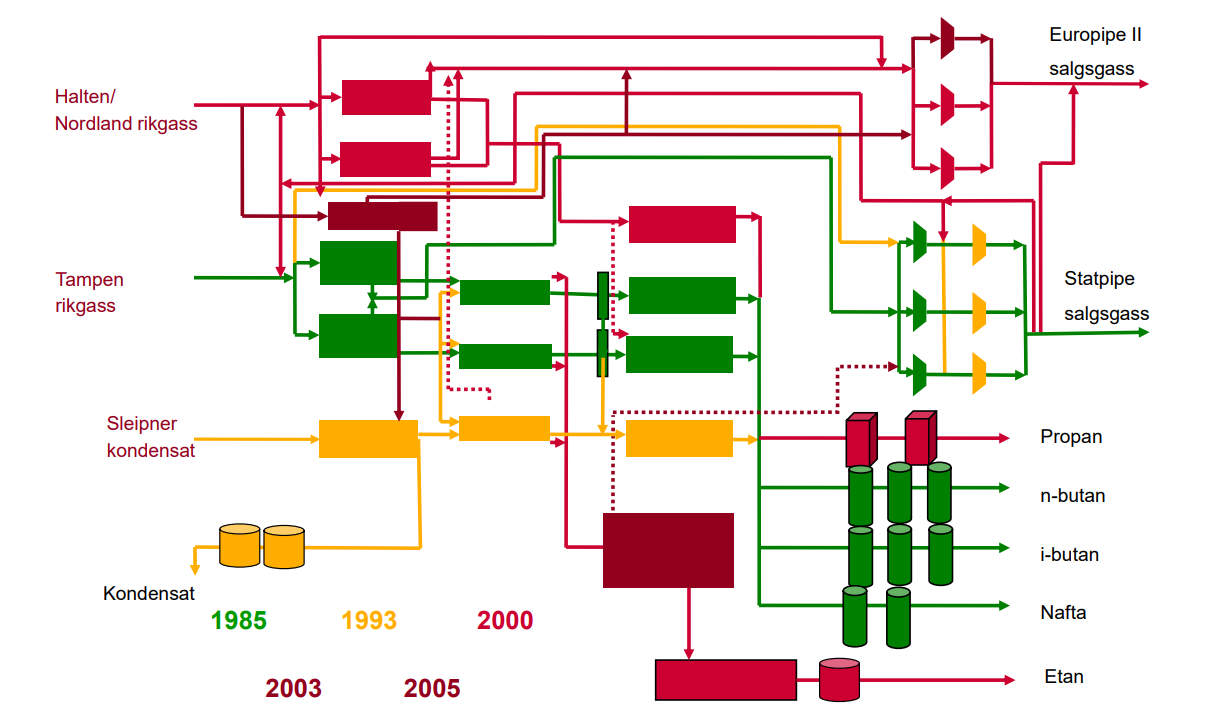
Before Gullfaks gas is sent out to the market, it is not only blended with gas from other Tampen fields, but also with gas from entirely different areas — including the Norwegian Sea.
All gas flowing from the Tampen area through Statpipe, to Kårstø, is classified as rich gas — meaning it contains multiple components, both in liquid form (wet gas) and in gaseous form (dry gas).
When this rich gas arrives at Kårstø, it is separated into a number of products: methane, ethane, propane, mixed butanes, naphtha (natural gasoline), and stabilised condensate. The process resembles distillation — each product has a unique boiling point, and with the right pressure and temperature, they can be vaporised and separated.
Wet gas by ship, dry gas by pipeline
Wet gas is shipped to market by tanker. In a typical year today, nearly 400 vessels load wet gas products at Kårstø. In the early years — when Kårstø only received Statpipe gas — the number of annual departures was naturally much lower.
Dry gas, primarily methane, is transported by pipeline. When Kårstø opened in 1985, the processed sales gas (dry gas) was transported out of the facility through a separate export pipeline within the Statpipe system. From there, it was routed via the Draupner S platform (then called 16/11 S), on to Ekofisk, and further through the Norpipe gas line to Emden in West Germany. In 1982, three years before Kårstø came online, the owners of Gullfaks, Statfjord, and Heimdal signed a supply agreement with continental buyers lasting about 30 years.[REMOVE]Fotnote:Johnsen, A. (2008). Norges evige rikdom (s. 130–140). Oslo: Aschehoug.
As the Kårstø facility expanded, a more extensive network of gas pipelines was built to export dry gas. The most important of these is Europipe II (from Kårstø to Dornum in Germany), which has more than double the capacity of Statpipe (74 million Sm³/day compared to 24 million Sm³/day).[REMOVE]Fotnote: The Statpipe pipeline from the North Sea transports rich gas, while Europipe II carries dry gas. The comparison should therefore be taken with a grain of salt.
That does not mean that all dry gas exported from Gullfaks ends up in Germany. Europipe II has a branch line leading to Denmark, from which gas can be sent onward to Poland via the Baltic Pipe — which opened the same day the Nord Stream pipeline was sabotaged.
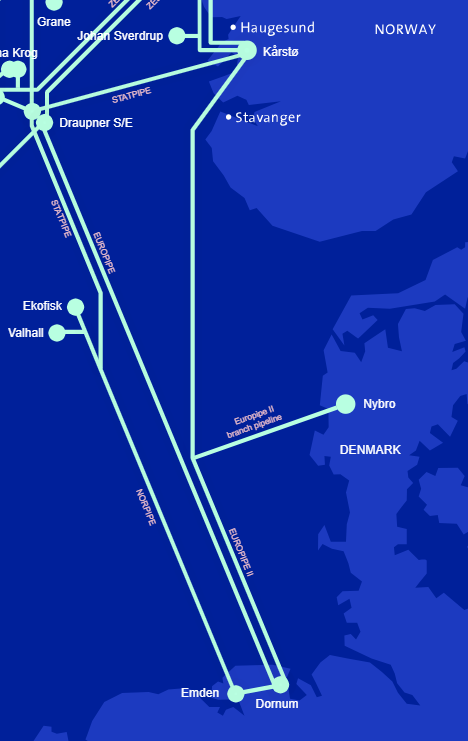
At the same time, Statpipe still runs through Draupner S, which is connected to Sleipner. This interconnection gives the system flexibility, allowing gas to be routed to Belgium, the UK, France, and Germany. As a result, Norway’s gas supply is not tied to any single buyer. This flexibility enables sellers to redirect volumes where prices are highest — a key advantage in negotiations.