
The Concrete Metropolis
1987. How did the village experience this transformation?

For a relatively small community (and the surrounding area), handling some
2,000 workers at once offered both opportunities and challenges. What if a
major accident happened? To what extent would locals find work and would
businesses thrive? What did people make of the boom, and how much did
Norwegian Contractors’ activity actually contribute in kroner and øre?
Emergency preparedness
Emergency preparedness was tested on 3 June 1987 in a large-scale drill
simulating an explosion on a barge moored alongside Gullfaks C, with three
fatalities and fourteen injured. It was the largest disaster exercise in
northern Rogaland since 1980.
The drill involved the Joint Rescue Coordination Centre, the hospital in Haugesund, the police, and physicians in Vindafjord. One lesson was that routines for keeping a continuous head count on the platform could be improved. The same applied to information flow to the public, the press, and relatives. In addition, it took too long
before the “injured” reached shore.[REMOVE]Fotnote: Vestvik, Einar and Carlsson, Ronny S. 1987. NC testet ny beredskapsplan med katastrofeøvelse: «Eksplosjon på Gullfaks C, minst tre drept og 14 skadd». In: Haugesunds Avis 04.06.1987, pp. 1 and 22.
Local recruitment and ripple effects
The Gullfaks B substructure arrived in Vats on 29 April 1987 to be mated
with the topsides. The project team counted about 130 people, many of whom
were quartered on Gullfaks B. Some 400–500 from Rosenberg Verft were housed
in barracks at Raudnes. Their task was to install the connections between
the concrete base and the topsides on Gullfaks B. The platform departed for
the field on 31 July.[REMOVE]Fotnote: Is, brus og ny plattform. (no author) In: Status, nr. 5 29. april 1987, p. 6.
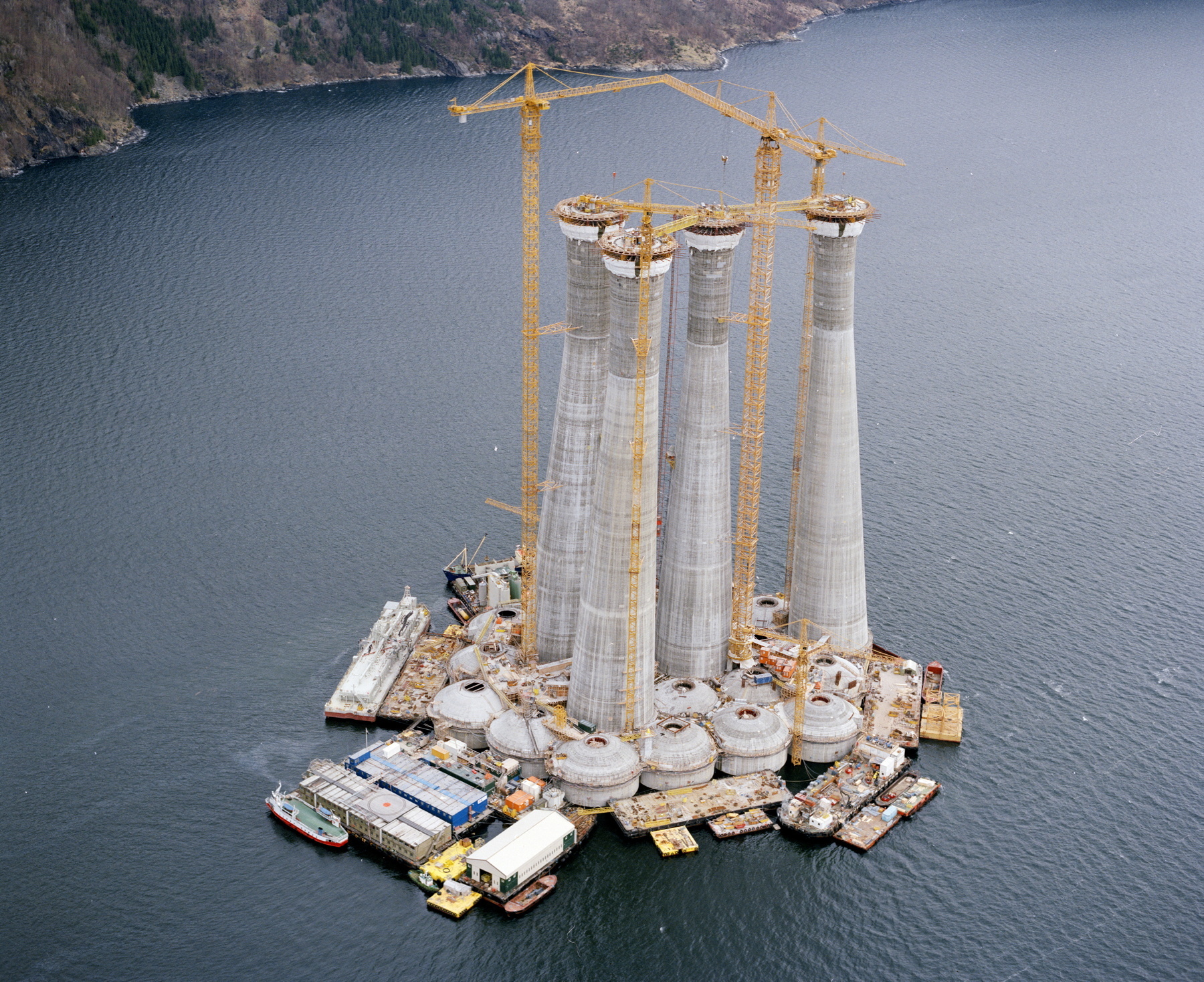
The base section for Gullfaks C arrived in Vats at the end of May. The main
slipforming phase—the vertical casting of the cell walls atop the base—
was scheduled to start on 8 July. This meant casting work, not just mating
topsides and substructure, and would require a very large workforce—far
more than earlier Vats projects. Recruiting enough people therefore became
a major job in itself. NC pursued an explicit recruitment strategy focused
on Vats and the surrounding area. The logic was simple: for every worker
able to go home after their shift, the need for a bed in the Raudnes camp
by Vatsfjorden shrank.
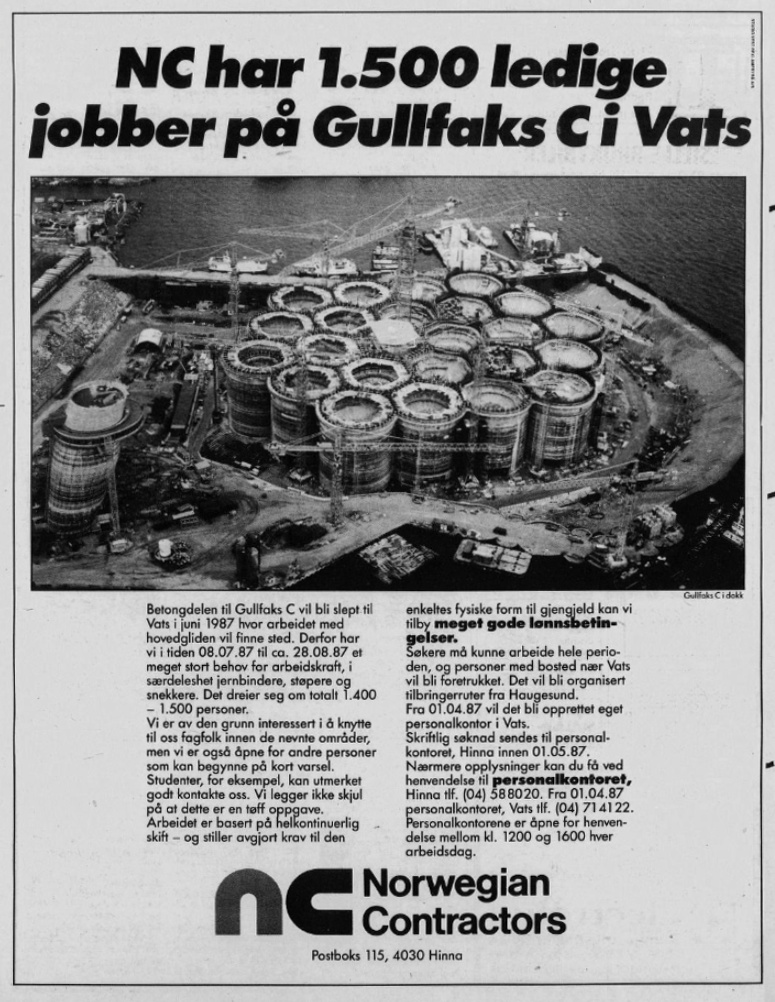
The big projects in Vats naturally drew substantial attention, not only
locally but regionally as well. Haugesunds Avis reported that Gullfaks C
would produce “considerably greater ripple effects for local residents and
businesses than any of the previous platform operations in Vats. In July
and August alone, around 2,000 temporary employees will be fully engaged in
casting work. A large share of these will be people from northern
Rogaland.”[REMOVE]Fotnote: Amble, Bjarte 1987. Gullfaks C skaper lokal optimisme: Ankommer Vats tirsdag kveld. In: Haugesunds Avis 25.05.1987, p. 2.
Svein Ove Vik, head of the Vats and Skjold Business Council,
believed the Gullfaks C project would mean “stronger competition for local
labour but also greater purchasing power among residents.” His bottom line
was that this was positive for the local economy, especially since NC, over
the years, had become increasingly open to local suppliers.[REMOVE]Fotnote: Amble, Bjarte 1987. Næringslivet i Vindafjord ligger frampå: Gullfaks B og C skaper aktivitet. In: Haugesunds Avis 27.05.1987, p. 1.
Among those hired from the area for Gullfaks C, there were two main groups.
One consisted of experienced rebar fixers and concrete workers; the other
was inexperienced youths who, over time, could step into those roles. The
inexperienced handled tasks such as pushing wheelbarrows of concrete.[REMOVE]Fotnote: Heggebø, Thorleif 1988. «Raske penger på gliden: Prester, bønder og
studenter i kø». In: Status (Statoil) 1988, Nr. 5, pp. 8–9. https://www.nb.no/items/95b68bcc9236fe101ad4543f69b14e13?page=7&searchText=%22Gullfaks%20C%22
Pay for the unskilled was good—about NOK 110 per hour—but NC’s
communications manager, Vidar Vorraa, stressed that people would earn it:
he said workers would “feel it in their arms” after the seven weeks, as the
job involved pushing heavy concrete in wheelbarrows and lifting rebar.[REMOVE]Fotnote: 200 på «sommerjobb» i Vats: -Nesten som i militæret (u. forf.) 1987.
In: Haugesunds Avis 08.07.1987, p. 2.
The soon-to-be student Knut Molnes Jr. from Etne said his first encounter
with industrial Vats felt strange: everything was new, and he admitted he
didn’t feel particularly confident those first hours. He started on the
night shift, and fortunately that first night was not too fast-paced, which
made for a softer introduction. Those first wheelbarrows full of cement
were wobbly, he said, but he later got into the groove—vibrating concrete
in addition to hauling it.[REMOVE]Fotnote: Eidhammer, Anne Ma 1987. På Raunes er det plass for alle. In: Grannar 16.07.1987, p. 5.
What did older locals think about taking jobs in the concrete works?
Per Gunnar Heggebø, a mason from Ølen (a short drive northeast of Vats), said
the pay was undeniably tempting. He also thought it would be fun, for a short while, to try a place that gathered people from all over the country. He spent his summer holiday on the concrete project. Johannes Nygård from Bjoa (north of Ølensvåg) had previously run, among other things, a transport firm, but profitability had been limited. He said it was exciting to try something new that he had heard much about but never done before— and, as he put it, the pay did not exactly detract from the appeal.[REMOVE]Fotnote: Eidhammer, Anne-Ma 1987. Gull(faks)feber. Spaning og pengar lokkar. In: Grannar 16.07.1987, p. 5.
The commuter and the room-hunter
Some employees commuted daily (especially early on) across Boknafjorden,
which could be demanding for anyone not a committed early bird.
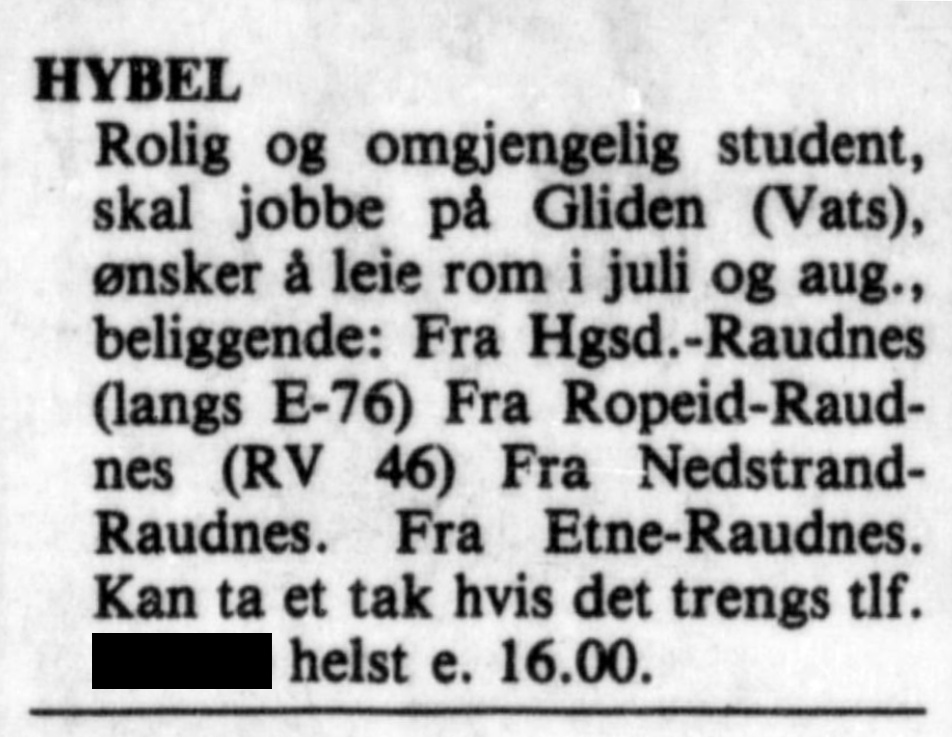
One worker, Else Marie, admitted she did not load her wheelbarrow too full on day one. She hoped to get a bunk in Vats soon, because, for the standard day shift start, she had to set the alarm for four in the morning when commuting from
Stavanger—too early, in her view.[REMOVE]Fotnote: Bikuben i Vats. In: Stavanger Aftenblad 21.07.1987.
Local opinion and NC’s contributions
Vindafjord’s mayor, Trygve Mikal Viga, summed it up by saying the
municipality had, over time, grown used to having platforms “visit” the
fjord. But he added they had never before had two platforms being worked on
at once, nor such a prolonged operation as the Gullfaks C concrete build.
They had been very curious how the summer influx would play out. So far, he
had not noted any material downsides.[REMOVE]Fotnote: Reynolds, Inger 1987, Bygda som fikk storinnrykk. In: Status nr. 5,
19.08.1987, p. 17.
The mayor pointed to increased road traffic through the village, especially
to and from Raudnes, but at the same time the municipality had gained a
four-kilometre road to the Raudnes yard and upgrades to other roads.[REMOVE]Fotnote: See Ny veg til Raudnes opna (no author) In: Haugesunds Avis 02.07.1987, p. 17, and Reynolds, Inger 1987, Bygda som fikk storinnrykk. In: Status nr. 5, 19.08.1987, p. 17.
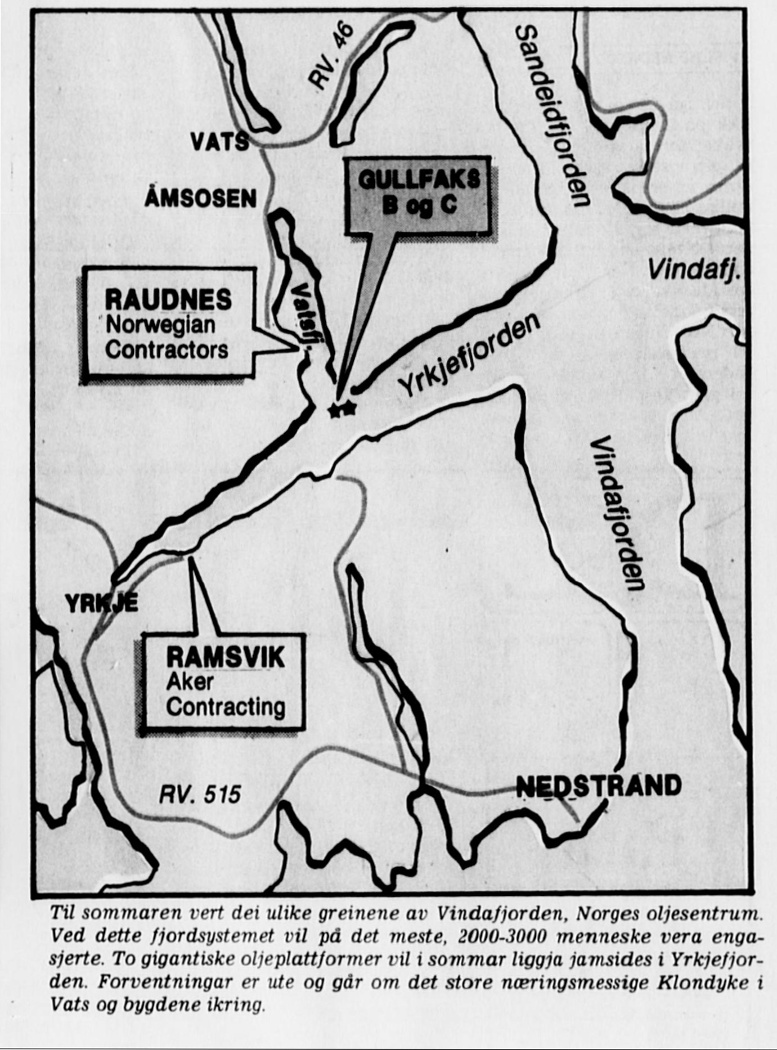
Norwegian Contractors spent a two-digit million-kroner sum on roadbuilding
linked to the Raudnes industrial area.[REMOVE]Fotnote: Førde, Thomas et al. 1987. Historisk sommer: Klondyke i Vats. In:
Stavanger Aftenblad 27.03.1987, p. 13. See also: Ny veg til Raudnes opna
(no author) In: Haugesunds Avis 02.07.1987, p. 17.
Tysvær municipality also got a new road to the base at Ramsvik (south of Yrkjefjorden), which Aker Contracting had built.
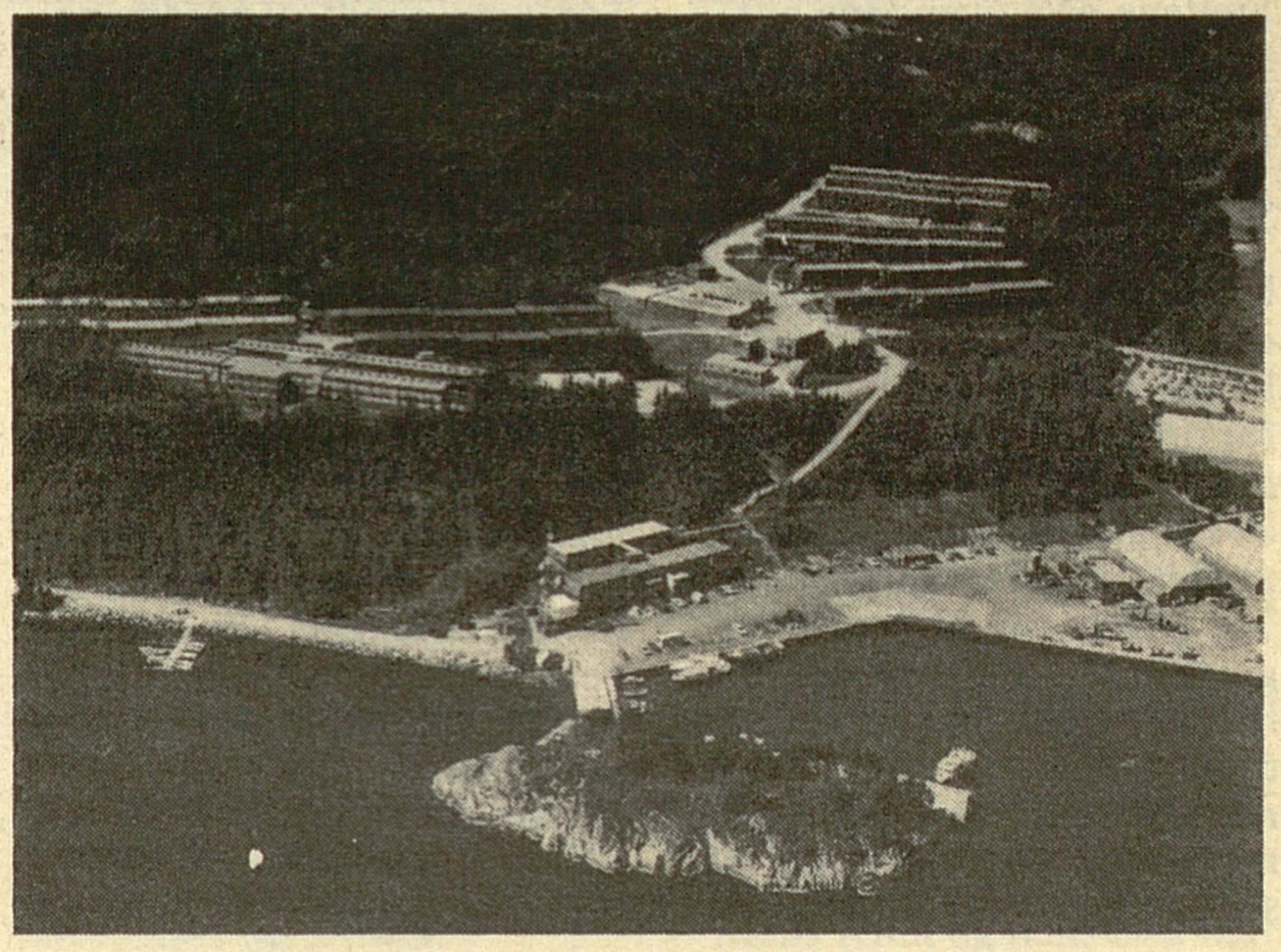
There was no doubt the community reaped several benefits from NC’s
presence. In 1983, Norwegian Contractors granted five million kroner toward
what—together with municipal funds and volunteer efforts—became the
Vindafjordhallen complex, with a culture venue and swimming pool. The
building was completed in 1993 at a total cost of NOK 20 million.[REMOVE]Fotnote: Førde, Thomas 1994. Fryktar framtid utan betongkjemper. In: Stavanger Aftenblad 04.05.1994, p. 29. See also Førde, Thomas 1993. Prektig kulturhus i Vats: Oljedrypp og dugnad. In: Stavanger Aftenblad 17.04.1993, p. 38.
In connection with the big influx, NC also built a new sports hall at
Raudnes. This rescued Vindafjord’s local volleyball push, which could not
meet approved playing conditions (ceilings too low) in the local gyms for
third-division play. Otherwise the team would likely have withdrawn. It was
no surprise, then, that Haugesunds Avis ran the headline “Oil saved
Vindafjord volleyball.”[REMOVE]Fotnote: Ringodd, Hans Inge 1987. Olja berget Vindafjord-volleyballen. In:
Haugesunds Avis 09.01.1988, p. 10.
In short, Vindafjord municipality did get to share a bit of the oil wealth,
though still far from what neighbouring Tysvær had long enjoyed as host to
Kårstø.
Some of Mayor Viga’s neighbours expressed admiration for what was going on,
while also noting the aesthetic limits of platforms: impressive feats and
technology, yes—but it was just as well the platforms would stand out in
the North Sea. They were fine to look at, but not so fine that locals
wanted them there forever.[REMOVE]Fotnote: Reynolds, Inger 1987, Bygda som fikk storinnrykk. In: Status nr. 5,
19. august 1987, p. 17.
At the end of July 1987, Gullfaks B was towed out of Vats, and at New
Year’s 1988/89 Gullfaks C also left the area, bound for Stord to be mated
with its topsides. The enormous workload was over.
What next, Vats?
Read more in: The Quiet After the Boom? and From Backwater to «Norway’s Oil Capital»