
The C deck and substructure meet

At the turn of the year 1988/89, the deck and the jacket of Gullfaks C were located a few kilometres apart, at Aker Stord’s yard in Leirvik and in the Digernessundet sound a little farther south, respectively.
Norwegian Contractors won the contract to load the topsides onto barges and transport them to Digernessundet for mating with the substructure. The contract was worth nearly NOK 100 million.[REMOVE]Fotnote: Norsk oljerevy / Norwegian Oil Review. 1987, Vol. 13, No. 9, p. 51. Aker Stord was tasked with connecting the main interfaces of the topsides to the concrete structure in Digernessundet. Because of bad weather, the tow only started after several postponements, which cost Statoil [now Equinor] NOK 10 million.[REMOVE]Fotnote: Status (1989), No. 4, p. 12. “The storm costs millions.
Between 2 and 3 a.m. on February 27, the tow of the topsides began. During the day, work started to set the topsides onto the substructure. In total, 355 bolts were to fasten the two together. This demanded high accuracy in fine-tuning the positioning of the topsides relative to the substructure. At 6 p.m., the two parts made contact for the first time. Late in the evening, around 10 percent of the topsides weight had been transferred to the concrete structure.
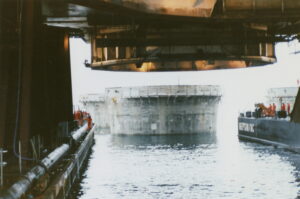
Early on the morning of March 1, the full topsides weight rested on the substructure. On March 3, the platform had been raised so the topsides stood 56 meters above sea level, and the next day the first Statoil [now Equinor] representatives came aboard.
Aker Stord had a seven-week window (four weeks less than originally planned) to finish preparations before tow-out to the field. Project manager Torleif Gram at Aker Stord therefore looked ahead to a very busy period, noting that the limited weeks remaining had to be used to the fullest, requiring good planning and follow-up.[REMOVE]Fotnote: For more information of the mating operation, see several shorter articles by Tor Resser et al. In: Sunnhordland, 28 February 1989, pp. 1 and 10. (The quotation is taken from p. 10 under the headline “Busy Days at Aker Stord.”)
The Tow from Vats to StordA heavyweight at the christening