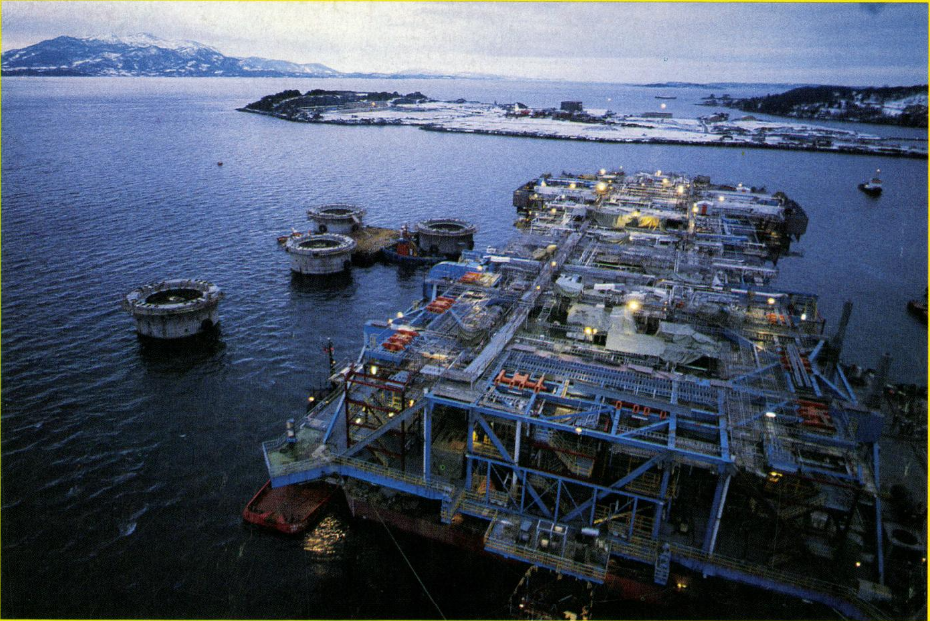
The A-deck for Aker Group

On May 6, 1983, it became official: the contract to build the deck frame for Gullfaks A was awarded to Aker Group and Stord Verft, rather than Moss Rosenberg Verft, which had built the decks for both Statfjord B and C just a few years earlier.[REMOVE]Fotnote: Sletten, S., & Tagesen, D. (1983, 6. mai). Rosenberg tapte i kampen med Stord. Stavanger Aftenblad, s. 9.According to Statoil, both bidders had submitted strong proposals, but Stord offered a significantly lower price. The decision was a major disappointment for Moss Rosenberg Verft, which had expected to have a strong chance, especially since they had already secured the contract for outfitting the shafts of the same platform. Meanwhile, there was great celebration in Stord.
The contract for constructing the deck frame was valued at NOK 650 million in 1983 (equivalent to NOK 2.2 billion in 2024). In addition, the contract included options for further work, such as mating the deck with the substructure in early 1986 and final preparations before tow-out to the field. These additional tasks were worth approximately NOK 200 million in 1983 terms.
Aker Stord’s bid for constructing the Gullfaks A deck was considered very low.[REMOVE]Fotnote: Hagland, J. (1983, 2. juni). Gullfaks-syndromet – Stord og Rosenberg. Stavanger Aftenblad, s. 40. The total contract value was less than half of what had been awarded for the Statfjord C deck just three years earlier.[REMOVE]Fotnote: Even though the two decks were very similar, the comparison should be taken with a grain of salt. The scope of work covered by the two contracts may not have been identical.
Construction begins
Construction of the steel deck began on August 19, 1983. The first task was to weld the first of four flanges that would later connect the deck to the concrete substructure[REMOVE]Fotnote: Status: internavis for Statoil-ansatte. (1983). Nr. 14, s. 2.
The steel frame formed the foundation of the deck—a structural base onto which all modules and components would be installed. The first phase of construction took place in the dry dock at Aker Stord.
By December 1984, nearly a year and a half after construction began, the steel frame was completed. The following months were dedicated to installing electrical systems and instrumentation.
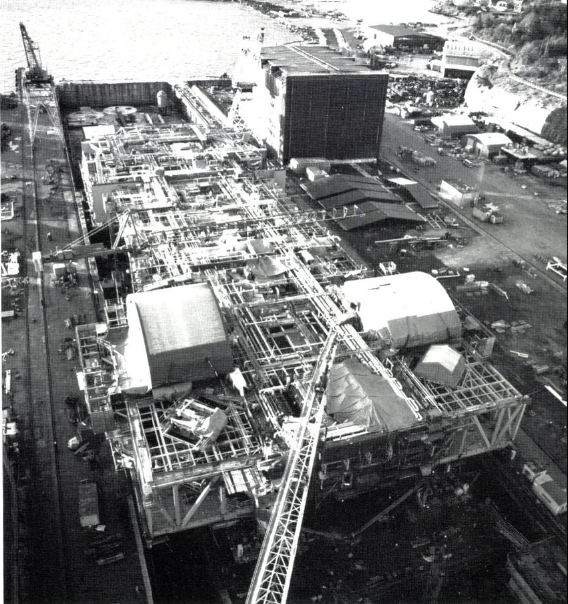
The deck construction process had some similarities to the substructure construction in that it began in a dry dock and was later moved to the harbor basin. However, unlike the substructure, which rises due to buoyancy when air is pumped into its base, the deck could not float on its own. To enable tow-out, the deck was therefore built on top of barges, allowing it to float as the dry dock was flooded.
In the early hours of February 22, 1985, the deck frame was floated out, and by 1:00 PM, it was in place in the harbor basin. The operation was timed to coincide with high tide, which was essential for the move.[REMOVE]Fotnote: Status: internavis for Statoil-ansatte. (1985). Nr. 3, s. 16.Once positioned, the structure was placed onto four concrete pillars, designed to mimic the tops of the shafts on which the deck would later be mounted.[REMOVE]Fotnote: Status: internavis for Statoil-ansatte. (1984). Nr. 18, s. 15.