
Statoil Takes Over as Operator on Gullfaks and Statfjord

Alongside Statoil’s push to become vertically integrated[REMOVE]Fotnote: That is, to be involved in everything from exploration to petrol stations. and to expand internationally, the operator role is a crucial factor for understanding the company—especially in its first three decades.[REMOVE]Fotnote: These focal points, together with the operational, are also used by Eivind Thomassen (2022) in Middel og Mål. Statoil og Equinor 1972-2001.
Universitetsforlaget, pp. 33–35.
Large development projects such as Gullfaks and Statfjord were central in the company’s “adolescence,” and they also help illustrate how different fields were affected by the major reform debate of the 1980s, a process that preceded Statoil’s twin debut as a production operator around the turn of 1986–87.
A reformed production operator
Gullfaks was the first field where Statoil served as operator from the start
(development operator)—with an ownership/equity interest of 85 percent.
It thus became Statoil’s first “home-grown” oil child—made real through
steel and concrete giants in the very heaviest weight classes. The crowning
achievement was Gullfaks C.
It must also have been hard for Statoil’s management to accept that the
equity interest in the field was cut from 85 percent to 12 percent in
connection with the mid-1980s Statoil reform. The purpose of the reform
was to curb Statoil’s financial power by channeling large parts of the
company’s oil-business cash flow directly to the state.
In this way Gullfaks symbolizes both a major victory and a major financial
loss—at least as seen by Statoil’s leadership and the Labour Party. The
centre-right Willoch government saw it differently and argued that Statoil
should be “reined in” through reform. The disagreement shows how
Statoil stood in a complex landscape of business and politics.
It all ended in a cross-party compromise: the Labour Party accepted large
cuts to Statoil’s equity interests in many fields in exchange for the company
keeping its 50 percent interest in Statfjord—something that would have
great financial importance for the company in the years ahead.
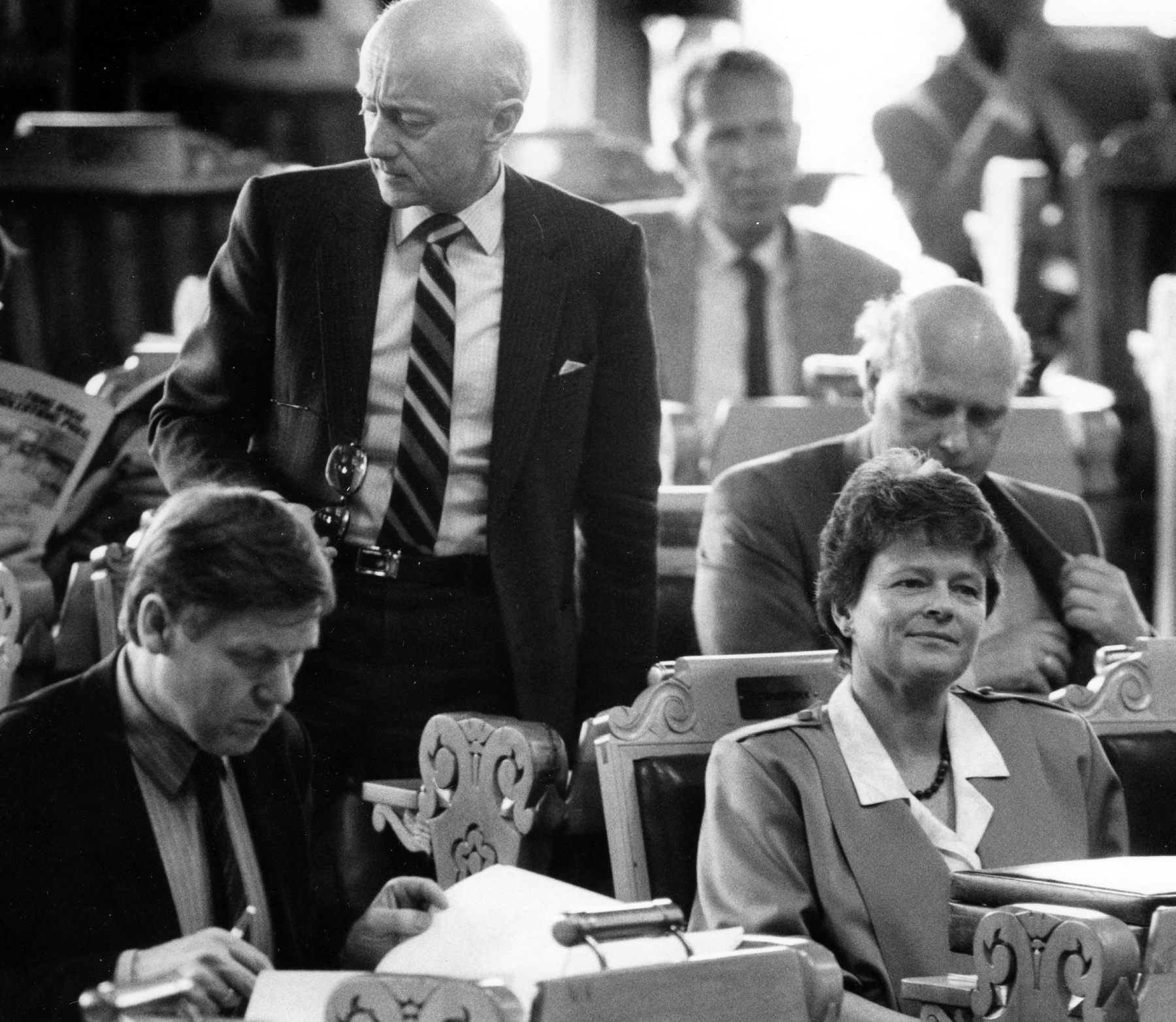
Despite reformist headwinds, Gullfaks and Statfjord remained pioneer
fields for Statoil in its role as production operator. On Gullfaks, the
company had first been development operator before moving into the
operations phase with production start on Gullfaks A on 22 December 1986.
In Statfjord’s case, the company took over as production operator from
Mobil on 1 January.
Corporate culture
Heading into the partial privatization in 2001, Gullfaks and Statfjord still
played very central roles on both the income and cost sides of the company.
In addition, distinctive cultures in the unions and operating organizations
would continue to exert significant influence on Statoil’s corporate culture
even after privatization.[REMOVE]Fotnote: See Thomassen 2022, p. 358. He writes, among other things: “With their large operations organizations and distinctive trade-union landscape, Statfjord and Gullfaks added significant complexity to the governance of the company into the 2000s.”
These structures and cultures were to a large extent the legacy of how
these two fields evolved toward—and in—the production-operator role.
In connection with this privatization, Statoil also bought back significant
parts of its ownership in Gullfaks and other key fields on the Norwegian
continental shelf. In 2013, Statoil held a 70 percent equity interest in
Gullfaks, before selling down to 51 percent the same year.
The combination of triumph and defeat tends to etch itself into long-term
memory—for people and for companies. In that sense, Gullfaks has helped
shape Statoil’s/Equinor’s institutional identity at the intersection of
business and politics.