
“Shift 7”

Heidi Frette retired in summer 2024. She was on board when Gullfaks A was towed out in 1986 and has worked on the platform ever since. When representatives from the Norwegian Petroleum Museum met her, it was her second-to-last trip offshore. Health challenges meant she could have retired earlier, but she says she needed some time to feel ready. Although many she worked with before had already left, there were a few of “her people”, including colleagues she got to know in recent years, that she wanted to keep working with a little longer.[REMOVE]Fotnote:Heidi Frette (Cook), in conversation with Julia Stangeland, Gullfaks A, June 26, 2024.
Retiring from a life offshore is not quite the same as retiring from a life onshore. When you work on land, you can always drop by your old workplace if you feel like catching up on the latest news. However, you can’t just drop by the platform.

Even though you can meet former colleagues onshore, and many do, it can still be hard to meet everyone. Many live spread out over a large geographic area. Frette herself lives with her family in Geilo. She is therefore grateful for Facebook as a way to stay in touch with former colleagues.
Loss of experience
The three Gullfaks platforms each have a Facebook page where people who work or have worked on the respective platforms can join. Many of the posts are greetings to people who have now moved on to “shift 7”.[REMOVE]Fotnote: The Facebook groups “People of Gullfaks A,” “People of Gullfaks B,” and “People of Gullfaks C,” groups intended for individuals who work or have worked on the respective platforms.
With two-weeks-on and four-weeks-off rotation, each platform needs three sets of offshore workers. Each set is roughly split into a day shift and a night shift. There are, of course, exceptions, because not every task requires night work. Either way, there are six shifts. The seventh shift is reserved for retirees.
– On many of the upcoming hitches the Offshore Installation Manager will be bidding farewell to a colleague who is retiring, said Frode Abotnes, Production Director for the Gullfaks area.[REMOVE]Fotnote: Frode Abotnes, in conversation with Shadé B. Martins, Ole Kvadsheim, and Julia Stangeland, Sandsli, Bergen, June 27, 2024.
During the museum’s visit to Gullfaks A in late June 2024, we met many people with long service on the platform. Some have worked there since what several called “the very beginning”, that is when the platform was new in 1986. It is nearly 40 years ago now. Among those who have worked on the platform for a long time, many will retire in the next few years – those who have not already done so.
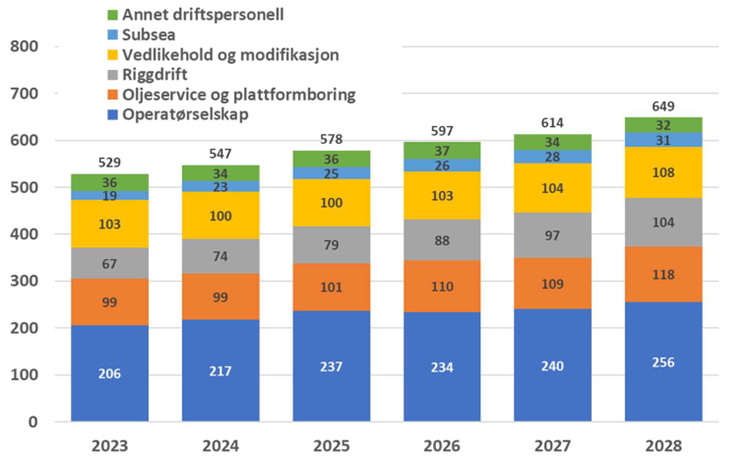
A report from the research institute NORCE confirms that many offshore workers will retire in the years ahead. The report shows a recruitment need rising gradually from around 550 people in 2024 to about 650 people in 2028. Mainly the new hires will replace people aged 58 to 65 (and some older) who are retiring, but in some cases it is about replacing people who are moving from offshore to onshore jobs.[REMOVE]Fotnote: Øystein M. Fjelldal and Atle Blomgren (both NORCE), Offshoreansatte 2018–2023, Report no. 23-2023, Helse og Samfunn, 48–49, https://norceresearch.brage.unit.no/norceresearch-xmlui/bitstream/handle/11250/3120611/NORCE%20H%26S%20rapport%20nr.%2023-2023.pdf?sequence=1&isAllowed=y, accessed August 1, 2024.
The report also shows that recruitment needs are greatest among people with a trade certificate. The need will be between 250 and 300 people annually.[REMOVE]Fotnote: Fjelldal and Blomgren, Offshoreansatte 2018–2023, 50. Some of these will replace workers who also hold a trade certificate; others will replace unskilled personnel. Among those with no formal education beyond lower secondary school, or who attended upper secondary but do not have a trade certificate, the vast majority are over 50.[REMOVE]Fotnote: Fjelldal and Blomgren, Offshoreansatte 2018–2023, 47.
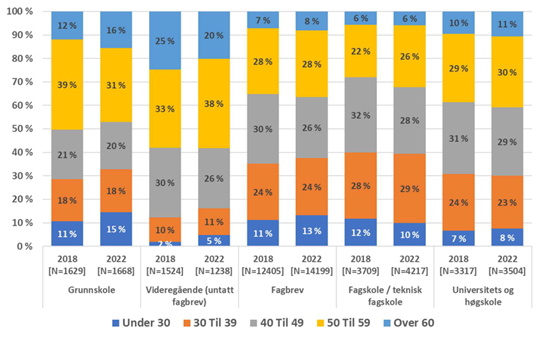
It is also important to remember that formal education used to be seen as less important, and many of the people being replaced have built up tremendous experience over decades – experience that can be hard to replace.
Generational shift
The key is to stay ahead of the curve. No one is required to decide on retirement until three months in advance. In some contexts that is tight – especially given the offshore rotation.
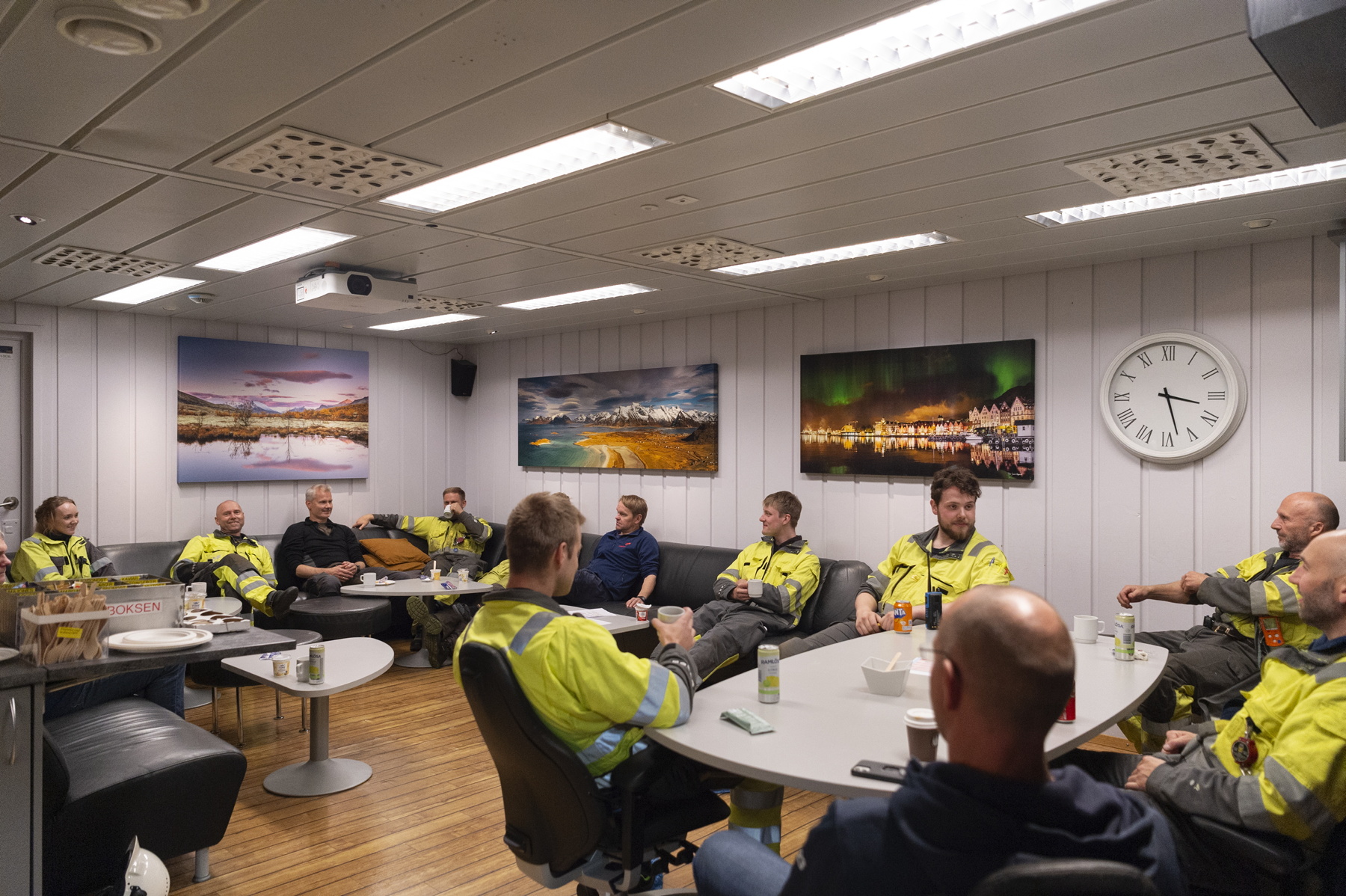
Ideally, says the Offshore Installation Manager (OIM) on Gullfaks A, Bjørn E. Solheim, you let new and experienced staff work together for a period. That way the seasoned offshore worker can pass on what he or she knows, knowledge that might otherwise remain tacit, while the newly graduated colleague brings in fresh knowledge in the field.
Such deliberate pairings can spark a bit of generational friction. Solheim tells of an older male offshore worker who grumbled when he had to bring along a young female colleague. It did not take long before the grumbling turned into praise and a thumbs up.[7]
Training and taking in apprentices is important as more offshore workers, in time, follow Heidi Frette and start on “shift 7”.