
Removing Gullfaks’ Concrete Substructures

The three options considered for the Gullfaks concrete substructures are full
removal, partial removal, or leaving them in place.[REMOVE]Fotnote: The question of leaving concrete substructures in place is addressed in a separate article. A more detailed analysis of full removal — including transport, dismantling, recycling, as well as equipment and facilities — can be found in: AF Decom Offshore (2011). “Utredning om tekniske
utfordringer knyttet til transport, mottak og disponering av
betonginnretninger ved land – OD prosjektnummer 105801 AFDO
prosjektnummer 6001.116.”
https://www.sodir.no/globalassets/1-sodir/publikasjoner/rapporter/
af-decom-offshore-as-disponering-av-betonginnretninger.pdf This article addresses the first two.
When assessing the feasibility and method for any potential removal, it is
important to consider how the structures were once transported and installed.
Steel installations are typically transported and installed using heavy‑lift
crane vessels and/or barges. What sets concrete substructures apart is the
large inherent buoyancy of their hollow concrete cells and shafts. That was a
major advantage during tow‑out to the field: only towing power was needed to
move the structures from the fjords to their locations on the continental
shelf—even though most concrete structures were far heavier than steel ones.
Complete removal of the concrete substructure
Given the way the Gullfaks platforms’ substructures were originally towed to
the field, an obvious scenario is to try to refloat the substructure. Several
factors make this challenging. A key unknown is how firmly the parts that
penetrate, in some cases, many tens of meters into the seabed (the skirts) are
held in place. Accurately estimating the skirts’ pull‑out resistance is
critical to success. In addition comes, among other things, how aging may have
affected the structures’ capacity to withstand the loads imposed by a refloat.[REMOVE]Fotnote: Meling, John; Hausmann Rikke Ellingsen og Faulds, Eric (2018). Markedsrapport knyttet til avslutning og disponering/Avslutning og disponering av utrangerte innretninger, project no. 12635-01, document no. 12635-01-OO-R-001 (Dr.techn. Olav Olsen AS.) (The report was written on commission for the then Norwegian Petroleum Directorate, now the Norwegian Offshore Directorate.) https://kudos.dfo.no/documents/12201/files/12330.pdf
Also published at: https://www.sodir.no/aktuelt/publikasjoner/rapporter/eldre-rapporter/markedsrapport-knyttet-til-avslutning-og-disponering2/8-beskrivelse-fjerning-av-bunnfaste-plattformunderstell/ (8.1.1) Only a handful of refloat projects for concrete installations have been carried
out in northern European waters. None have taken place on the Norwegian
Continental Shelf (NCS). Among the very few removed by this method is the
loading column with a concrete foundation at the Maureen field on the UK
Continental Shelf (UKCS). The operation included pumping out the water that
had been used to keep the installation stable on the seabed. The concrete
structure consisted of a square base with a column 89 meters tall and between
6.5 and 9 meters in diameter.
The refloat operation was successful; the installation was towed to Stord and today serves as a breakwater for a marina there.
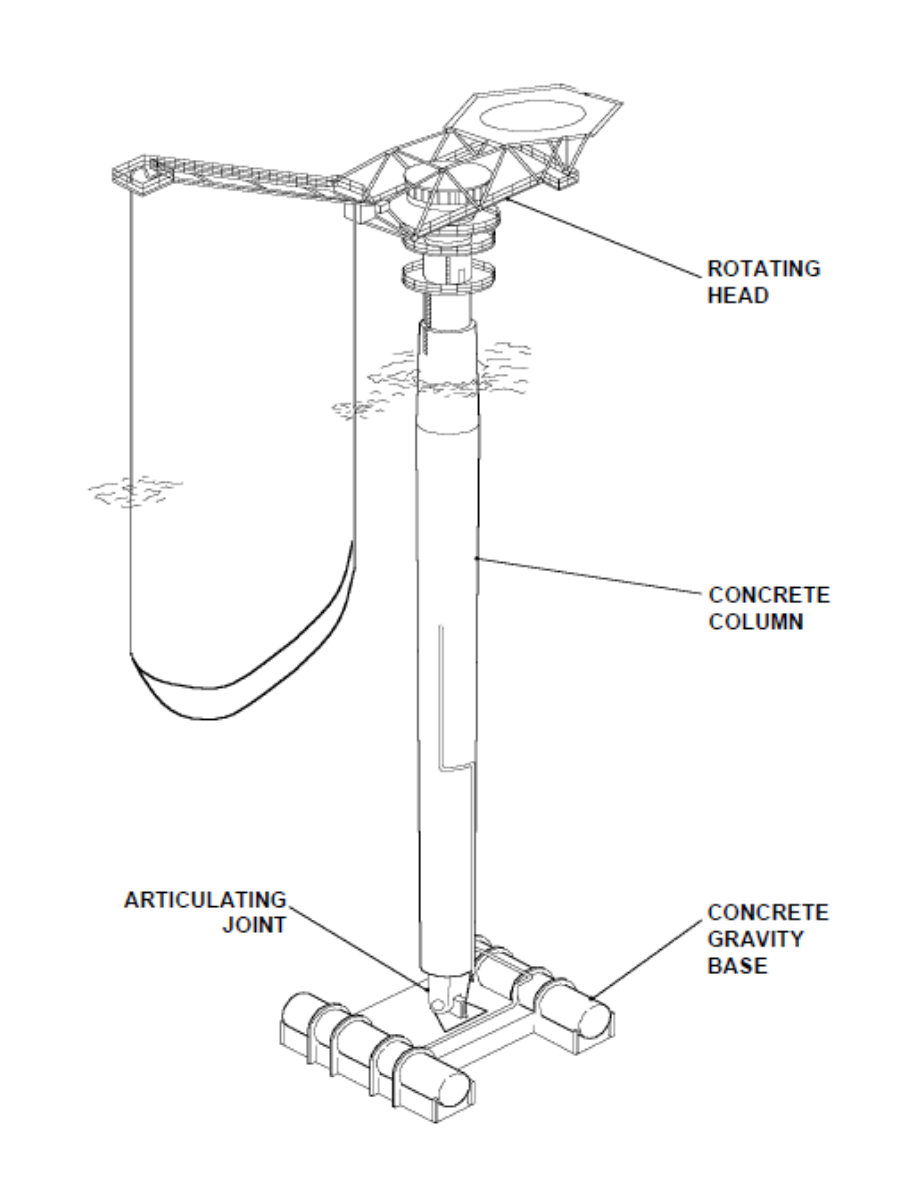
It is worth noting that the loading column at Maureen and other installations
that have been refloated (such as Schwedeneck A and Schwedeneck B on the
German shelf) are significantly smaller than many of the remaining concrete
installations on the NCS. In a class of its own stands the Gullfaks C
substructure at 1.5 million tonnes and 262 meters tall.[REMOVE]Fotnote: Gullfaks C had a total height of 380 metres including the deck. Gullfaks A and Gullfaks B had total heights of 270 and 220 metres respectively.
It remains to be seen whether the limited refloat experience can be extrapolated across the full range of sizes and weights of concrete substructures on the NCS in general, and for the Gullfaks platforms in particular.
Partial removal
Partial removal of a concrete platform substructure may look like a pragmatic
middle ground when full removal or leaving the structure in place seems
difficult. But this option also presents significant challenges. The main
objective in a partial removal is usually to cut away the upper sections of
the shafts so that shipping can pass unhindered above the installation. The
international standard calls for removal down to 55 meters below the lowest
tide level.
Cutting reinforced concrete under water is no simple task, not least because
it depends on extended periods of calm weather. Weather exposure complicates
stability calculations for the cut section as the work progresses.[REMOVE]Fotnote: Meling, John; Hausmann Rikke Ellingsen og Faulds, Eric (2018). Markedsrapport knyttet til avslutning og disponering/Avslutning og disponering av utrangerte innretninger, project no. 12635-01, document no. 12635-01-OO-R-001 (Dr.techn. Olav Olsen AS.) (The report was written on commission for the then Norwegian Petroleum Directorate, now the Norwegian Offshore Directorate.) https://kudos.dfo.no/documents/12201/files/12330.pdf (s. 58.)
Also published at: https://www.sodir.no/aktuelt/publikasjoner/rapporter/eldre-rapporter/markedsrapport-knyttet-til-avslutning-og-disponering2/8-beskrivelse-fjerning-av-bunnfaste-plattformunderstell/(8.1.3)
There are no known examples of this kind of partial removal, as the overall risk has
been judged to outweigh the benefits.[REMOVE]Fotnote: Meling, John; Hausmann Rikke Ellingsen og Faulds, Eric (2018). Markedsrapport knyttet til avslutning og disponering/Avslutning og disponering av utrangerte innretninger, project no. 12635-01, document no. 12635-01-OO-R-001 (Dr.techn. Olav Olsen AS.) (The report was written on commission for the then Norwegian Petroleum Directorate, now the Norwegian Offshore Directorate.) https://kudos.dfo.no/documents/12201/files/12330.pdf (s. 71.)
Also published at: https://www.sodir.no/aktuelt/publikasjoner/rapporter/eldre-rapporter/markedsrapport-knyttet-til-avslutning-og-disponering2/8-beskrivelse-fjerning-av-bunnfaste-plattformunderstell/ (8.2.3)
————-
Taken together, this suggests that, for the Gullfaks platforms, the choice in
most cases will be between removing the entire concrete substructure or
leaving it in place.