
Oil transport

In the spring of 1984, it was decided that oil from the Gullfaks field would not be sent ashore through pipelines, but shipped by sea. That same year, I/S Gullfaks Transport was established.
I/S Gullfaks Transport
The company would carry crude on behalf of all license partners – Statoil, Saga Petroleum, Norsk Hydro, and later the State’s Direct Financial Interest (SDØE). Each license partner held the same ownership share in I/S Gullfaks Transport as they held in the Gullfaks field. Statoil served as the operator for the company, just as it operated the field itself.
The partnership I/S Gullfaks Transport had much in common with K/S Statfjord Transport a.s & Co, which handled oil from the Statfjord field. Neither company owned its own ships; instead, they used long‑term chartered vessels from several shipowners.[REMOVE]Fotnote: Statoil, Annual report 1990, 34, https://www.equinor.com/investors/annual-reports-archive.
The vessels used were so‑called shuttle tankers, ships designed to connect to the offshore loading buoys installed on these fields, among others.
Statoil insisted that any ships built for the service met a high standard. This mattered not only for economics and efficiency, but also for safety. Several new vessels were therefore purpose‑built.[REMOVE]Fotnote: Gunnar Nerheim and Kristin Øye Gjerde, Uglandrederiene: verdensvirksomhet med lokale røtter. Andreas K. L. Ugland og Johan Jørgen Ugland (Grimstad, 1996), 404–5.
Safety in oil transport
Gustav A. Waage, Statoil’s first head of maritime transport, set strict requirements for shuttle tankers:
- Segregated ballast tanks were mandatory.
- Two bow thrusters and a forward wheelhouse on the bow, to be used during loading operations.[REMOVE]Fotnote: John Ove Lindøe, From sea to shore : the shuttle tanker story (Stavanger: Wigestrand Forlag and Stavanger Sjøfartsmuseum, 2009), 87–88.
The Ugland vessels represented an innovation: - They were the first shuttle tankers built with double hulls, and the first with two main engines, twin rudders, and twin propellers.
- Extra propulsion power made tanker casualties less likely, and the double hull reduced the risk of oil leakage should an accident nevertheless occur.
- Later, in 1993, the UN’s International Maritime Organization (IMO) introduced double‑hull requirements for all ships built after 1993.[REMOVE]Fotnote: Lindøe, From sea to shore, 57–58.
The shipping companies Knutsen OAS in Haugesund and the two Sørlandet‑based firms Einar Rasmussen Rederi and AS Uglands Rederi were the three owners that carried oil ashore from the Gullfaks and Statfjord fields. The vessels were all relatively new and, as Gullfaks came on stream and was expanded with more platforms, additional shuttle tankers were needed.[REMOVE]Fotnote: Inge A. Alver, “I skytteltrafikk mellom oljefelta og Mongstad,” Strilen, March 18, 1992, 2–3, Nasjonalbiblioteket.
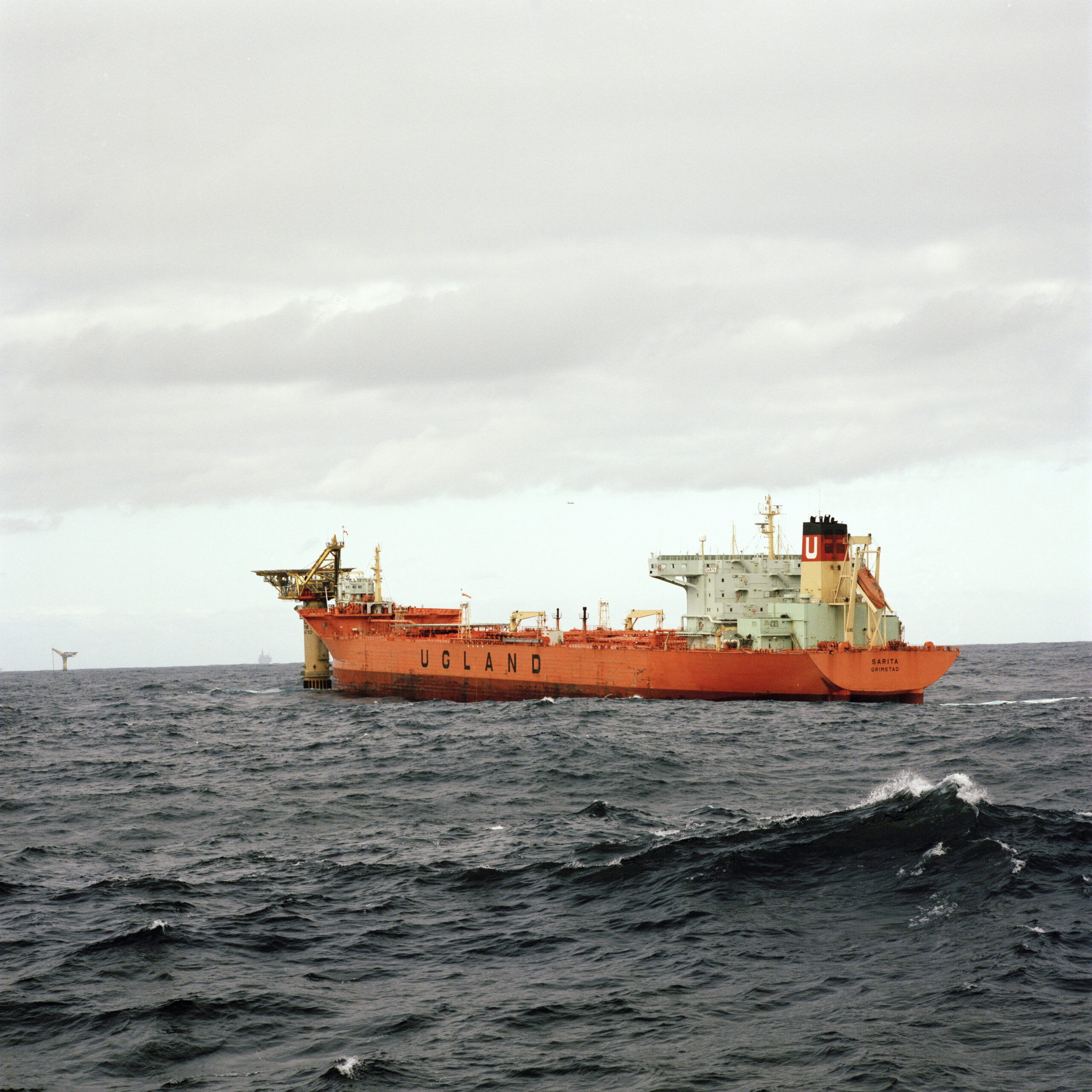
Because the fields had to be “tapped” regularly, the shuttle tankers could not range far. The crude was mostly shipped to “local” refineries around the North Sea basin, such as the Kalundborg refinery in Denmark, or to the refinery at Mongstad, north of Bergen.[REMOVE]Fotnote: Statoil, Annual report 1990, 34 Some Gullfaks crude was also stored temporarily at the Mongstad oil terminal. From there, conventional crude carriers would pick it up and carry it farther afield – for example to markets in Asia.[REMOVE]Fotnote: Lise Gro Ekholdt (former oil trader at Statoil/Equinor), in conversation with researcher Ole Kvadsheim, February 28, 2025.
The refinery and oil terminal at Mongstad had been expanded with exactly this future in mind: Norway would eventually gain significant volumes of oil from both Statfjord and Gullfaks.
Navion and Teekay
In 1997, I/S Gullfaks Transport and similar entities were folded into a new company called Navion.
Navion was created after Statoil decided to spin off its business area known as Shipping & Maritime Technology (SMT). The rationale was to sharpen the company’s core and at the same time invite partners to join the new business area.
Rasmussengruppen of Kristiansand, formerly Einar Rasmussen’s shipping company, was the only party interested. They bought 20 percent of Navion.[REMOVE]Fotnote: Lindøe, From sea to shore, 63 and 66.
John Ove Lindøe writes in the book From sea to shore : the shuttle tanker story that the collaboration was not a success, arguing that Statoil and Rasmussengruppen had not sufficiently clarified how it was meant to work.[REMOVE]Fotnote: Lindøe, From sea to shore, 71–73.
By 2000, Statoil’s shipping arm Navion was among Norway’s largest shipowners. In early 2002, the fleet stood at 60 vessels – 25 shuttle tankers and 35 other ships of various categories. In December that year, Navion was sold to the Canadian shipping company Teekay for 800 million USD, roughly five billion NOK.[REMOVE]Fotnote: Lindøe, From sea to shore, 63.
Under the Navion and Teekay agreement, Teekay received what was called a “depletion contract,” meaning exclusive rights to offloading and transport from a number of fields for as long as those fields remain in production.
In other words, Equinor could not simply decide to take over the shuttling of oil from the Gullfaks field to shore.
Shuttle loading after 2025
In early 2025, Teekay in turn was sold to the Greek company Altera. Whether they have assumed this exclusivity from Teekay remains uncertain.
What is certain is that Equinor is a company with a major need for maritime transport. As the company puts it on its website:
“Our seaborne transport of crude, refined products, liquid refinery products, liquid petroleum gas and LNG volumes involves more than 2300 voyages worldwide per year and moves about 100 million tonnes annually.”[REMOVE]Fotnote: “Shipping and sea transport in Equinor,” Equinor, https://www.equinor.com/energy/shipping, accessed January 24, 2025.
As of 2025, more than 170 vessels were at work daily collecting and transporting energy products and picking up and delivering goods and equipment.
Part of this operation is the fleet of shuttle tankers that carry oil from the Gullfaks field.