
Offshore Commissioning

After the towing and before the start of production, there is a certain amount of work that must be carried out. Work to prepare the platform began as soon as the platform was successfully installed on the field.
Aker Stord, together with Aker Offshore Construction and Aker Team, was
tasked with readying Gullfaks C for production at the field.[REMOVE]Fotnote: Norsk oljerevy / Norwegian Oil Review. 1990, Vol. 16, No. 4, p. 31.It was the first time the shipyard had received such a contract. The choice of Aker Stord was partly because the shipyard had built the deck. The shipyard claimed that this would allow for more efficient completion, which Statoil also admits was the case.
There is also no doubt that it was a task that was highly appreciated: Yard director Rolf Th. Waage said the real treat was testing and trials—getting to see all the systems work, and the complex process plant perform as intended.[REMOVE]Fotnote: Myklebust, Alf Terje (1994). 75 Years at Kjøtteinen 1919–1994. Jubilee Book for Aker Stord. Stord: Aker Stord, p. 130.
Prior to the tow, calculations were made to determine how much weight the platform could carry during the tow. The aim was for as much of the work as possible to be completed before the platform left the harbor. The reason for this was that performing work offshore is more expensive and riskier compared to doing it onshore.
Much of the work still had to be carried out at sea.
Commissioning of Gullfaks C employed 800 people. Of these, 500 were to live
on the floating accommodation unit (flotel) Polycastle.[REMOVE]Fotnote: Norsk oljerevy / Norwegian Oil Review. 1989, Vol. 15, No. 6, p. 41.
The accommodation platform had previously been on the Statfjord field and arrived at Aker Stord on April 12, 1989. It remained there until the tow of Gullfaks C started on May 2 and joined the tow. Polycastle was built in Japan and was
owned by Rasmussen Offshore in Kristiansand. It had almost 1,000 square
meters of outdoor storage and 660 m² of indoor storage and loading area.
It offered two‑berth cabins, along with most amenities for a decent life on
board, such as a cinema, laundry, gym, mess hall, TV room, and the like.[REMOVE]Fotnote: Resser, Tor (13.04.1989). “Polycastle” to Aker Stord. In: Sunnhordland, 13.04.1989, p. 2.
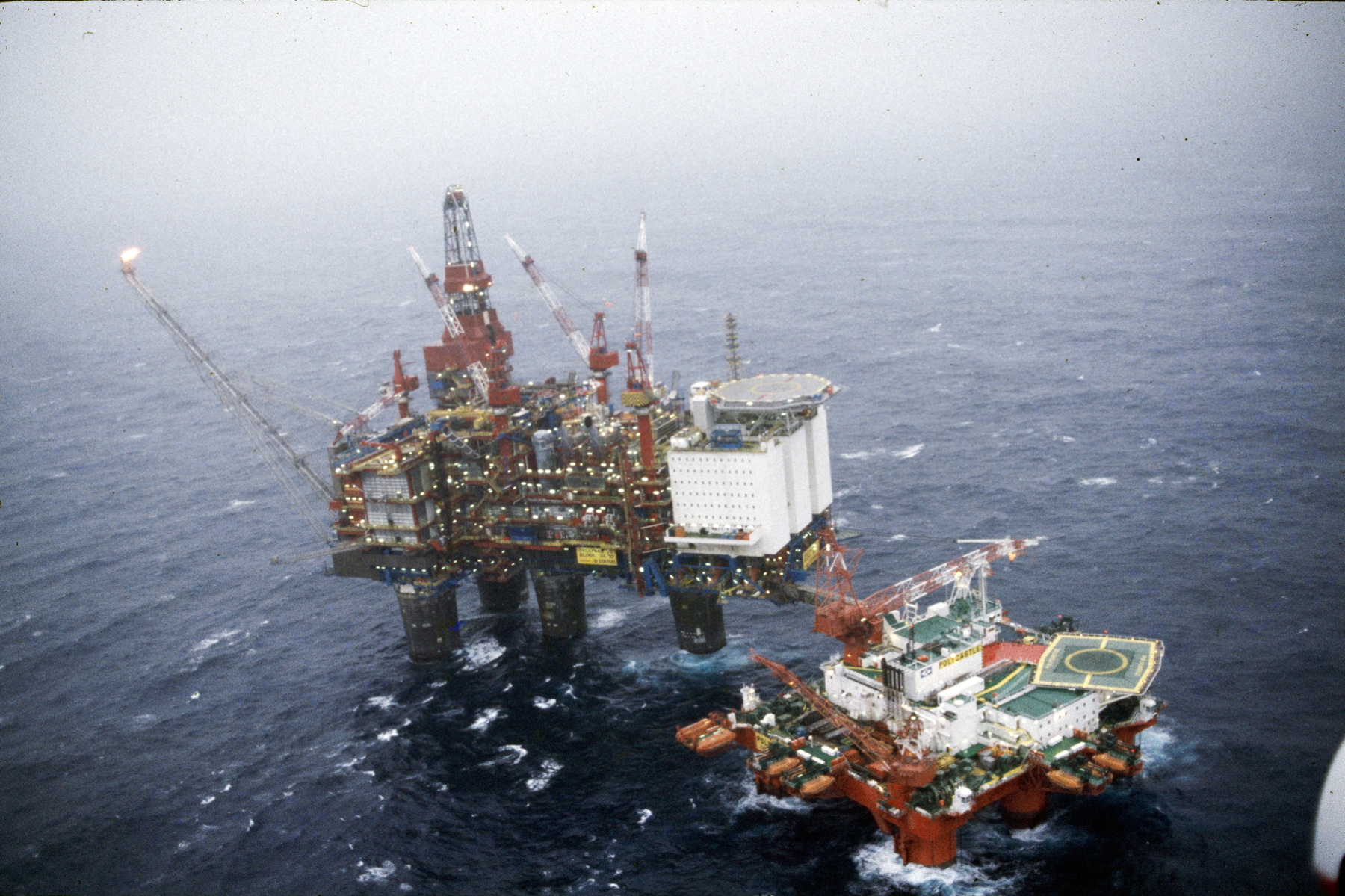
After about half a year of work, the giant—at the time the world’s largest platform—was ready to go on stream. Production began in November/December, six months earlier than originally planned.
The Tow from Stord to the FieldProduction start at Gullfaks C