
Next stop: the Gullfaks field

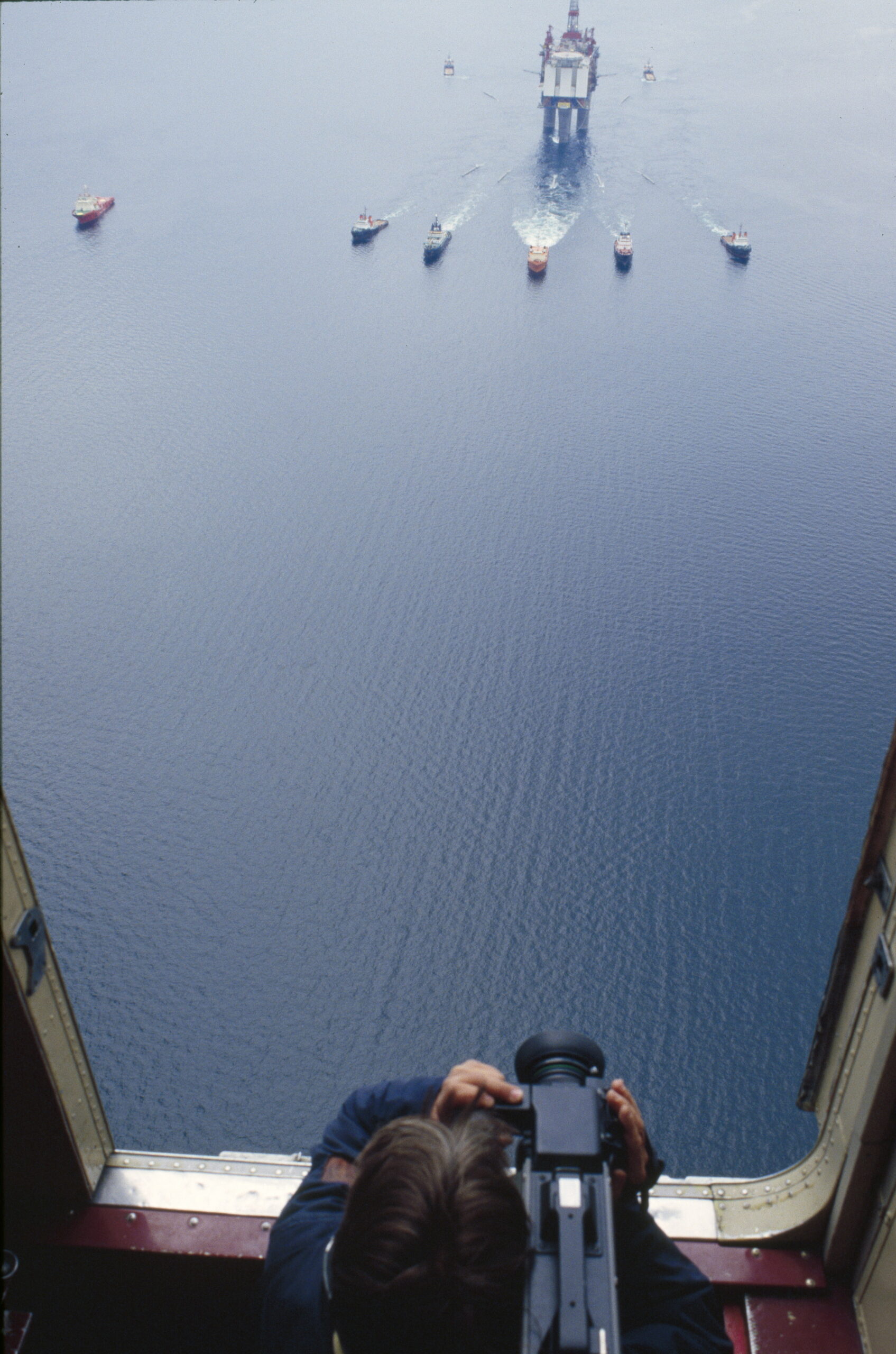
Barely a month after Gullfaks A had been christened, the 270-metre-tall platform was ready to be moved from Digernessundet to the Gullfaks field, a voyage of 143 nautical miles. The journey was especially long because, due to water depth and other conditions, the platform had to take a detour toward open sea.
The first leg of the trip went eastward into the Bømlafjord, before the platform headed north and passed through Langenuen. It then turned west, sailed through the Selbjørnsfjord, and from there continued straight northwest towards the Gullfaks field.


The tow was originally scheduled to begin on Sunday, 4 May, but strong winds meant that the anchor chains were not cut until the following day.
On Monday, 5 May, the eight tugboats—five pulling and three steering—were finally able to prepare to take Gullfaks A out to the field. In 1986, this operation was the largest tow ever carried out in connection with developments in the North Sea.[REMOVE]Fotnote: «Med kurs for Gullfaks» in Haugesunds Avis, Monday 5 May 1986, page 2. The National Library of Norway. It was later surpassed by both Gullfaks C and Troll A.
Four days later, on 9 May, Gullfaks A arrived at the field. The platform, which had been lowered to 125 metres for the tow, now had to be lowered a further 10 metres—to 135 metres, the water depth at the field.
Over the next two days, 200,000 tonnes of water would be pumped into the concrete cells so that the steel skirt would settle into the seabed.[REMOVE]Fotnote: «Gullfaks A framme på feltet» i Fædrelandsvennen, Friday 9 May 1986, page 17. The National Library of Norway.
After the platform was finally positioned on the field, another six months of completion work remained before it came on stream on 22 December 1986. Production started roughly half a year ahead of the original schedule, thanks in part to the fact that Gullfaks A initially produced oil from subsea wells rather than from wells drilled from the platform itself.
30+
In January 2026, Gullfaks A enters its 40th year as an oil and gas producer. In an article written when the platform had been in production for 30 years, it was noted that drilling in the 1970s revealed a large oil and gas reservoir. Even so, no one had expected production to continue for 40 years or more.[REMOVE]Fotnote: «30 years of Gullfaks oil». Article published on Equinor’s home page, on 22 December 2016. https://www.equinor.com/news/archive/30-years-gullfaks-oil Downloaded on 10 December 2025.
A significant reason why the Gullfaks platforms have been able to produce for so long is the additional supply of oil and gas from other discoveries, largely produced through subsea wells.
As of 2026, the time horizon for the Gullfaks field is that it will be able to continue producing until 2040, which would mean a total production period of more than 50 years.
[1] «Med kurs for Gullfaks» in Haugesunds Avis, Monday 5 May 1986, page 2. The National Library of Norway.
[2] «Gullfaks A framme på feltet» i Fædrelandsvennen, Friday 9 May 1986, page 17. The National Library of Norway.
[3] «30 years of Gullfaks oil». Article published on Equinor’s home page, on 22 December 2016. https://www.equinor.com/news/archive/30-years-gullfaks-oil Downloaded on 10 December 2025.
A christening among those closestAker Stord won the battle for the C deck