
Next stop: life offshore

You only get to travel offshore by helicopter once you’ve completed basic safety training and obtained a valid medical certificate.
Safety training
The safety course includes, among other things:
- HSE culture, prevention, and safe work
- First aid
- Collective evacuation
- Fire safety
- Sea rescue
- Helicopter evacuation
The four-day course alternates between theory and practice. Trainees practice evacuating a dark room and extinguishing fires with portable extinguishers and a fire blanket. They practice cardiopulmonary resuscitation (CPR) and conduct drills in the water. One exercise is escaping through a window from an overturned helicopter; another is righting a life raft at sea.[REMOVE]Fotnote:Maersk Training is one of the providers offering courses in Norway. Information about courses: “GSK Grunnleggende sikkerhetskurs,” https://resq.no/kurs/offshorekurs/gsk-grunnleggende-sikkerhetskurs, accessed July 3, 2024.
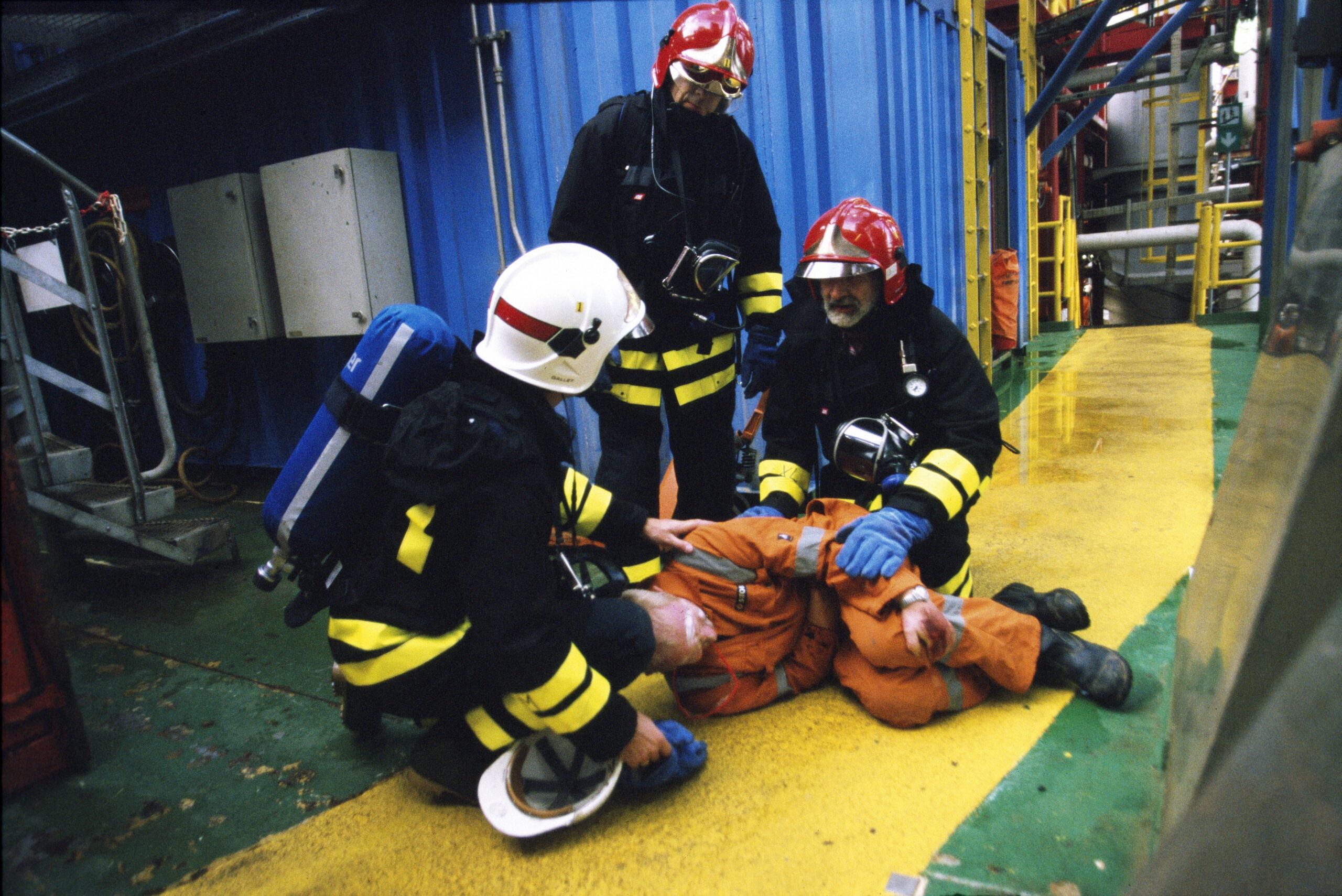
If you work regularly offshore you may have emergency response roles, be part of a fire team, or a first-aid team. In those cases, you’ll get extra instruction.
Before you can travel offshore, your shoulder width is measured. This checks whether your shoulders are too broad to escape through a standard helicopter window. People with very broad shoulders are assigned specific evacuation seats on the helicopter.
After passing the course, you’re almost ready to travel offshore, but first you need to confirm your health is up to standard.
Medical clearance
Every platform has an offshore nurse (medic) on board. They do preventive work, treat injuries that may occur, and handle any acute illness. Documented medical conditions you already struggle with can prevent you from working offshore.
To fly out by helicopter, you must undergo a medical examination with an approved offshore doctor. The exam is intended to rule out conditions that could endanger others or yourself. Poor vision or hearing, or heart problems, are examples.
Medical issues and other health factors you live with will be discussed during the exam. The offshore doctor will assess whether they are under control – for example stable and well medicated, or whether there is reason to deny travel offshore.
If you pass the medical, you’re ready to head for the platform.
The helicopter flight
Kenneth Alm Bendiksen, who works in the electrical and automation department on Gullfaks A, recalled taking his wife to the Petroleum Museum one time. As they walked past the helicopter area, he told her he would show her something. He then mimed how he sat down in a helicopter seat, closed his eyes, and fell asleep in record time.[REMOVE]Fotnote: Kenneth Alm Bendiksen, in conversation with Shadé B. Martins, Ole Kvadsheim and Julia Stangeland, Gullfaks A, 25 June 2024.
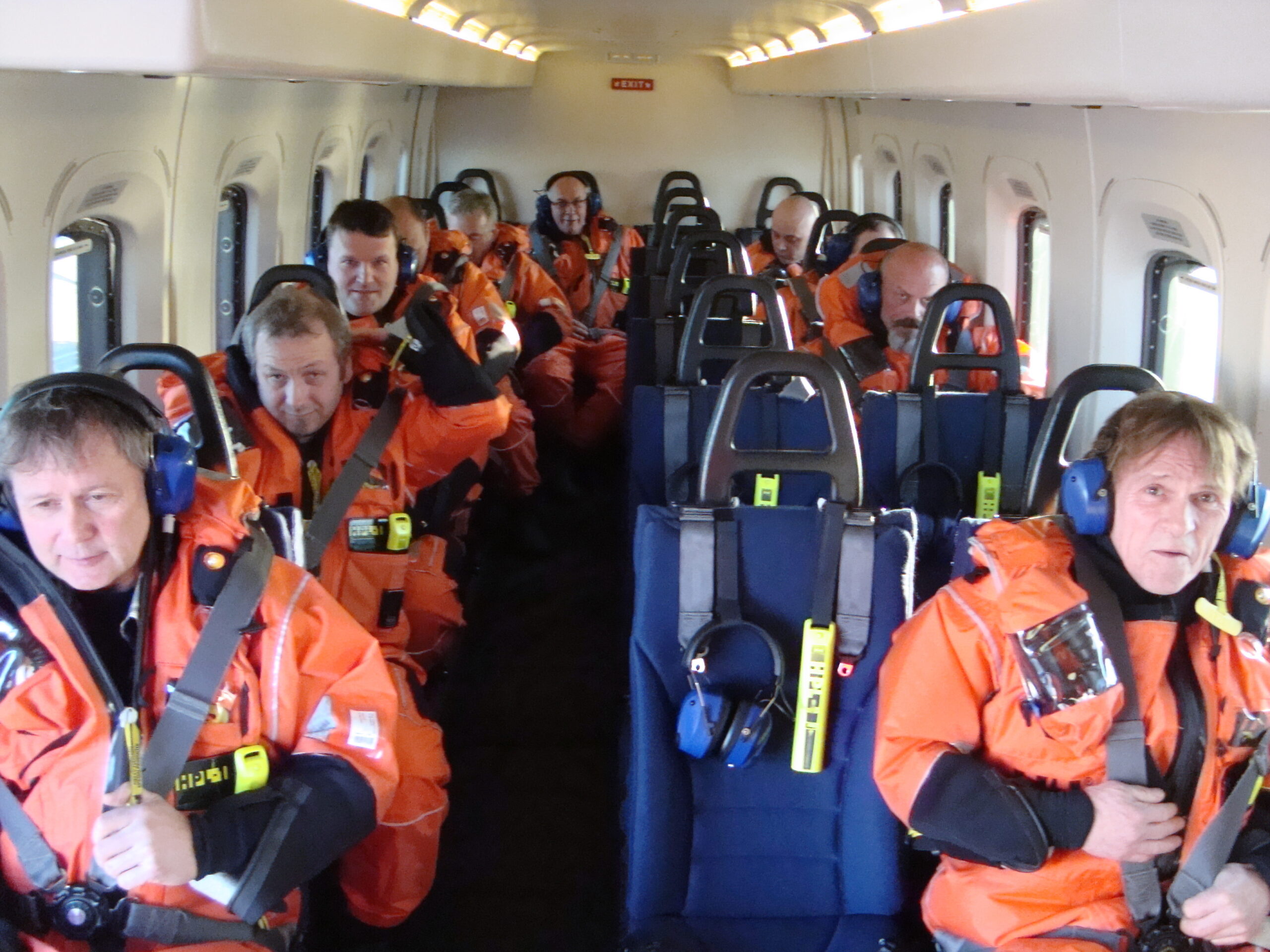
Whether he actually slept or just pretended is hard to say, but Alm Bendiksen is probably not the only one who uses the hour between Flesland and the Gullfaks field to get some sleep.
Before he and his colleagues can take their seats, they have to complete a few procedures.
Check-in is much like at an airport, but along with your boarding pass you are also given your cabin assignment and information on which lifeboat to muster to in an evacuation.
The baggage rules are stricter than on flights. You may bring only two pieces, ten kilos each, and there is no cabin baggage on the helicopter. If you carry medication it must be packed separately and opened together with the nurse on the platform.
A small book and a switched-off mobile phone (airplane mode is not sufficient) fit inside the survival suit and can therefore be brought along. You are issued the suit at the counter after the security check. The shoes you arrived in are put into a shoe bag before you don the suit, which also includes footwear.
Before boarding, a safety video is shown that covers fastening the seat belt, proper use of the suit, evacuation, and the use of hearing protection. The last thing you do before walking to the helicopter is insert earplugs.
On board, you put on the hearing protection hanging on the seat in front of you. Through it you hear information from the pilot and can otherwise listen to music. The personal locator beacon (PLB) hanging next to the headset is clipped to your suit. The PLB activates on contact with water. In an emergency it will transmit your position and make you easier to find.
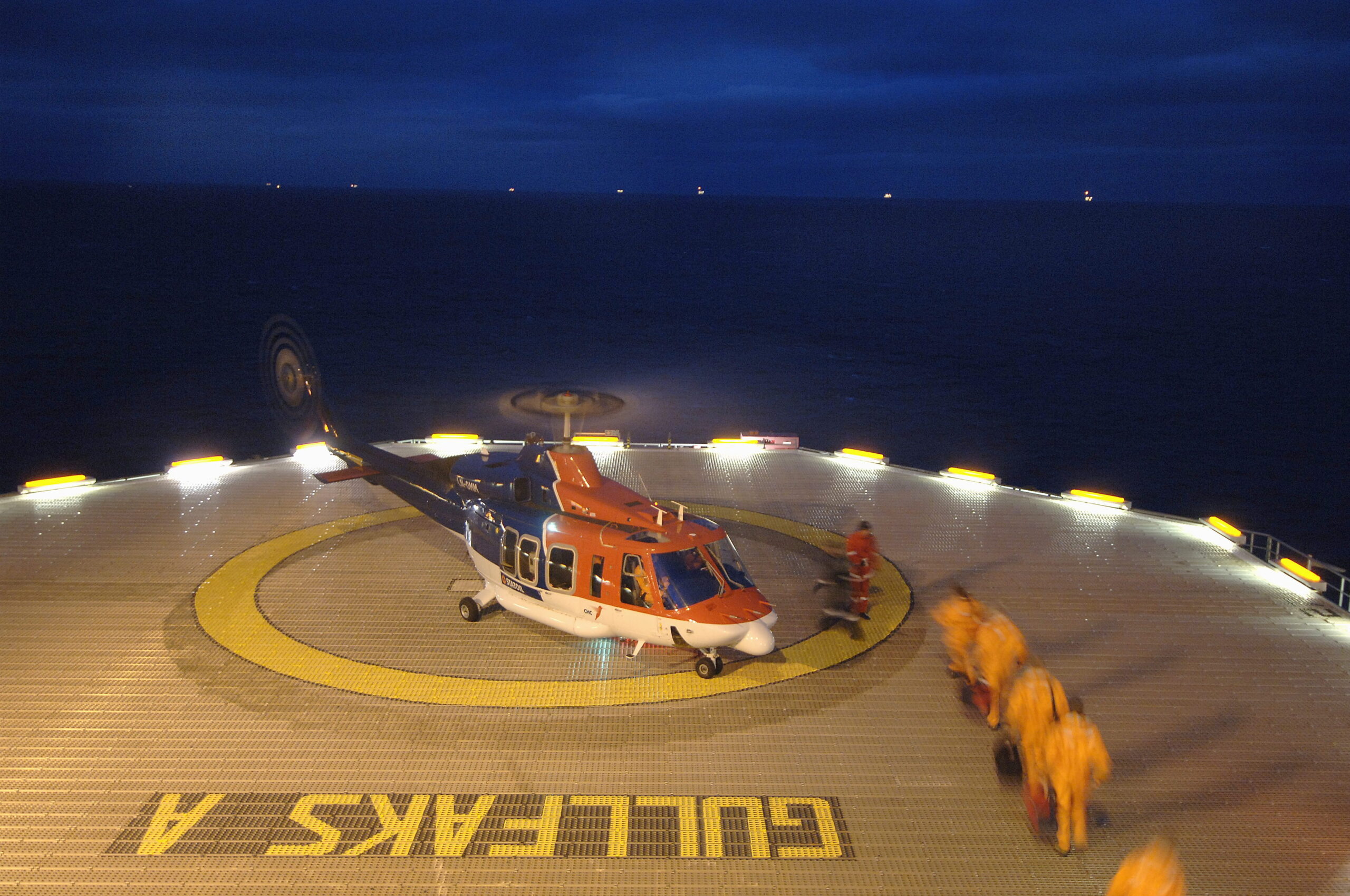
After about an hour you arrive at the Gullfaks field. You hang the headset and PLB back in their places. For the walk from the helicopter to platform reception, separate hearing protection is provided.
If you’ve been on the platform before, you can pick up your baggage and shoes, find your cabin, and get to work. If this is your first trip, the Offshore Installation Manager (OIM) will be there to “welcome you on board”.