
Mongstad to Gullfaks round trip

Logistics account for between 10 and 15 percent of a petroleum field’s operating costs. Base operations account for 15 percent of those logistics costs, while the remaining 85 percent are tied to helicopter traffic and shipping.[REMOVE]Fotnote: This text is largely based on information that Shadé B. Martins and Julia Stangeland received when they visited the supply base at Mongstad on 17 September 2024. During the visit, they spoke with supply manager Janne Thomassen, operations coordinator and security manager Arve Jostein Soltveit, CCB operator Roger Fredriksen, and return logistics coordinator at Mongstad, Frode Hodneland.
A supply base is a warehouse for equipment that offshore installations do not have room for, a transit hub, and a safety barrier. Everything sent offshore must be certified as safe—both the cargo itself and the containers used to transport it.
The Mongstad supply base
- Since 2015, Equinor has sent most of its supplies from this base.
- The supply base at Mongstad is owned by Mongstad Eigedom. Equinor leases storage and quay space from this company.
- Equinor holds a service agreement with Norsea Group. Norsea Group has chosen CCB as its service provider at both Mongstad and Ågotnes.
- The bases therefore operate under the names CCB Mongstad and CCB Ågotnes.
- CCB has around 500 employees at Mongstad, while Equinor has 10.
- The warehouse is open from 7 a.m. to 11 p.m. (8 p.m. on Saturdays). Loading and unloading also take place on Sundays, but the warehouse is closed.
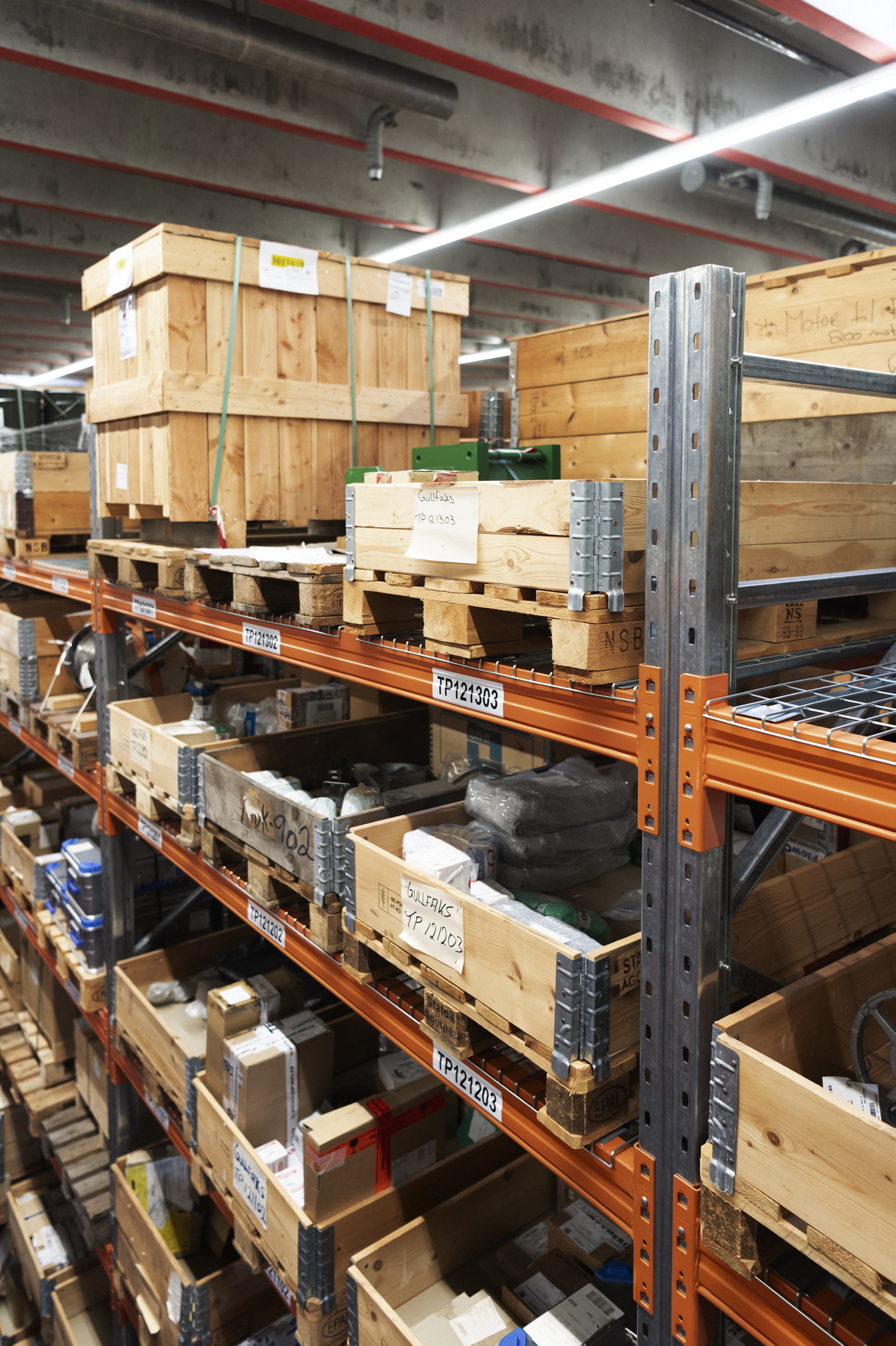
Older installations, such as the Gullfaks platforms, keep larger onsite inventories because they often have older machinery and equipment. Spare parts for these are not off-the-shelf items and may have long delivery times. They are therefore stored at the base.
Standard consumables on the other hand, such as work gloves and toilet paper, are not stored at the base. They arrive on one of the 50 trucks delivering goods to Mongstad each day.
At the warehouse
At Mongstad, the combined inventory value for the Equinor-operated licences is around NOK 3 billion. Of the 43,000 locations (pallets or storage positions) available, 6,000 are linked to Gullfaks—corresponding to 18,000 of the 75,000 unique spare parts held in stock.
Most items are stored in the old subsea hall and in a 6,000-square-metre warehouse constructed when Statoil consolidated much of its base operations at Mongstad.
In the old subsea hall, the former basin has not been filled in, but a concrete deck has been laid over it so that larger items that do not fit on pallets can be stored here.
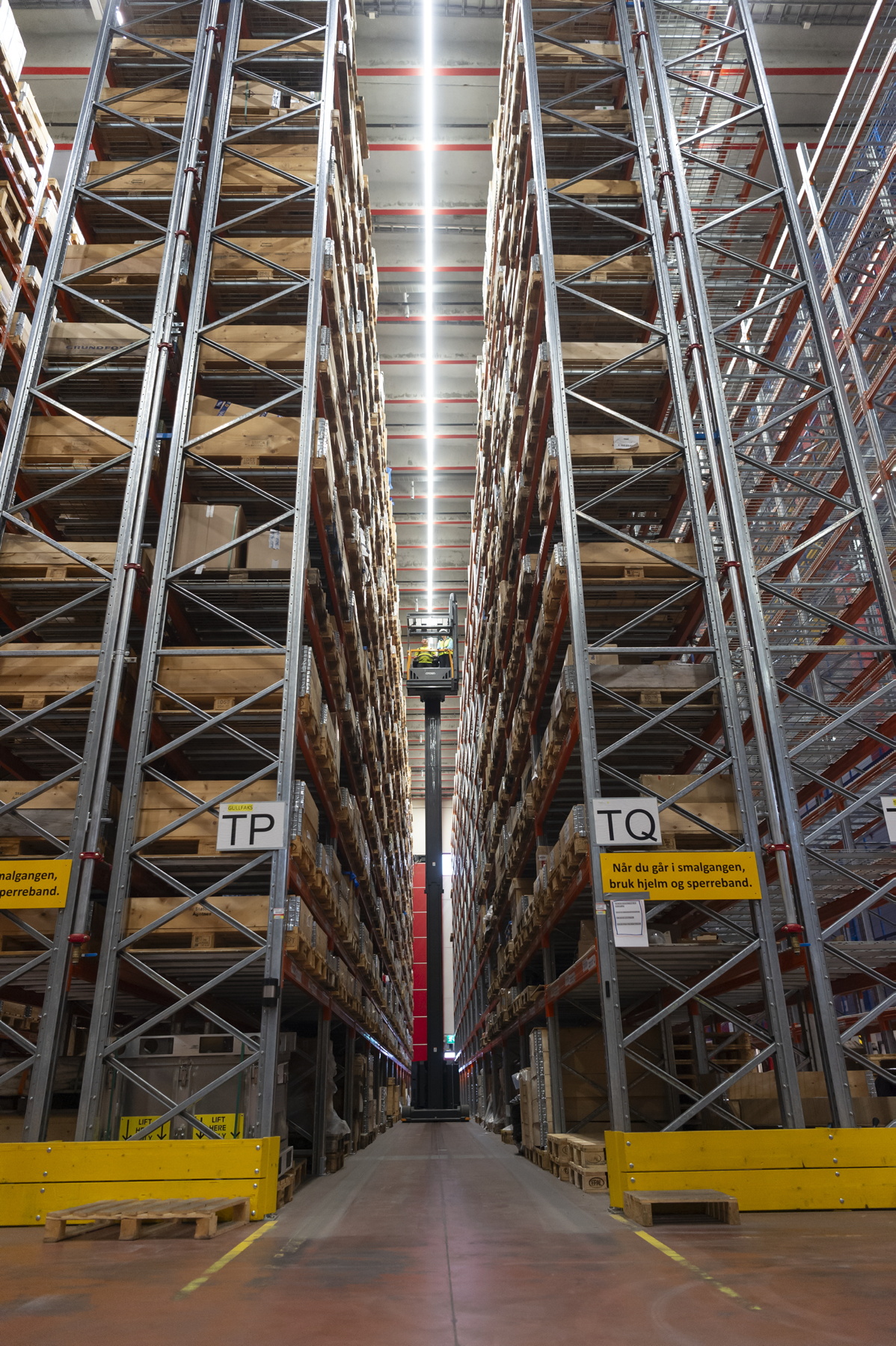
Between the 12-metre-high racks there is just enough space for an order-picking truck to pass. When the racking system was completed it was Norway’s highest picking warehouse. It may no longer hold that title, according to Roger Fredriksen, operator at CCB Mongstad, and Arve Jostein Soltveit, operations coordinator and security manager at Equinor. – Perhaps Asko or Toro have overtaken us? they speculate.
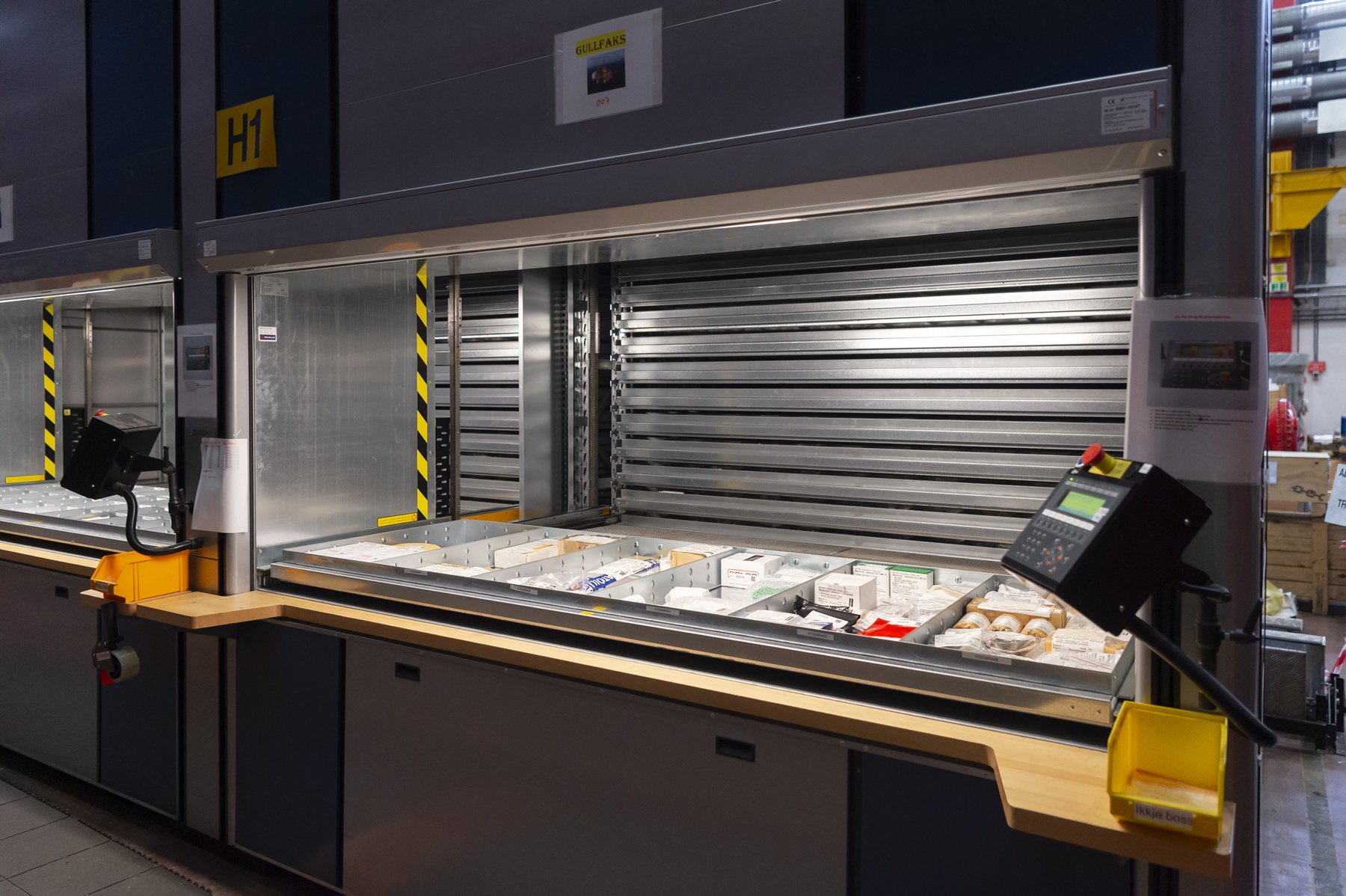
On the pallets are both items that are shipped regularly to the fields, and items collecting dust, but which may be needed at short notice.
What all these items have in common is that they are parts and pieces for which there is no permanent storage space offshore.
– Turnarounds[REMOVE]Fotnote: A turnaround (shutdown for maintenance) means that production is halted so that extensive maintenance and repairs can be carried out- work that cannot be performed while the platform is producing oil and/or gas. This typically includes hot work, which can be dangerous to carry out while the platform is receiving flammable oil and gas. Turnarounds usually take place during the spring or summer when the weather is good. in particular make things busy, with lots of equipment going out and returning, Fredriksen explains.
Goods needed by the platforms are typically ordered by the FA Manager (Supply and Administration), Drilling Logistics, or Operations Logistics. Some requests are generated automatically through the SAP system[REMOVE]Fotnote:SAP is a system used by, among others, Equinor. The system is used, among other things, for logistics.
. For example, the system may be set to trigger a reorder when only five or ten units of an item remain, such as work gloves.
Most cargo for offshore installations is packed into containers. Some companies—such as Kraemer Maritime, which supplies food to the platforms—pack their own containers. The rest are packed by CCB operators.
Espen Hodnekvam helped develop a data system that replaced printed Excel sheets. Printed sheets quickly became outdated as changes were made. The new system is therefore more dynamic.[REMOVE]Fotnote:Nordhordland, “Espen køyrde truck og koda på fritida. Resultatet er ein ny arbeidskvardag,” April 27, 2024, 12.
Each platform has its own staging area where cargo prepared for the next vessel is gathered.
Bus route, taxi, and a running meter
Goods are mainly sent via the regular vessels serving the three Gullfaks platforms. Soltveit likens these vessels to a bus route – the cheapest option.
Bringing in an additional ship, he says, is like taking a taxi. The licence may have to go to the spot market to secure a vessel, and depending on supply and demand, this can become expensive. But just as taking a taxi is sometimes worth it, ordering an extra vessel can be worthwhile when time is money and essential supplies must reach the platform.
Turnarounds, prolonged storms, and extraordinary events can create a need for extra vessels, but this is usually avoidable through planning and by prioritising what must be sent offshore and what can wait.
Sailing capacity also tends to be slightly higher than normally required. This is both to manage unpredictable events and because vessels may need to load return cargo before unloading their outbound goods at the platform.
From Mongstad to Gullfaks and back
- A trip from Mongstad to the Gullfaks field and back takes between 28 and 30 hours, depending on weather conditions.
- Sailing time from Mongstad to the Gullfaks field is 8 to 9 hours.
- Unloading/loading at the platforms takes about 3.5 hours per platform.
- The Gullfaks field receives ships on a fixed schedule every Tuesday, Thursday, and Saturday.
Offshore installations may occasionally require extra storage capacity, for example when a rig with limited deck and storage space undergoes a turnaround. The rig may then order a vessel to remain alongside until the work is completed—much like taking a taxi and leaving the meter running.
Bildekarusell
The vessel not only brings cargo out; it also brings goods and wasteback to shore.
Calm before the storm subsides
Return Logistics Coordinator at Mongstad, Frode Hodneland, describes ordinary waste and items heading back to the shelves as simple return work, whereas special waste, particularly radioactive waste, and items being sent off base for repair may be more demanding. Equipment leased by a licence or platform can also be challenging when returned.
Correcting mistakes takes more effort than doing it right the first time. Consequently, it can pay to check, and double-check, that shipping addresses are correct. Sometimes documentation is also incomplete. Hodneland fully understands how slowly new routines may take hold offshore. – If you receive training on something new just before going home for four weeks of leave, you more or less have to relearn it when you return for your next shift.
Hodneland adds that documentation for items shipped out cannot be closed until the item is actually back on the shelf. During quiet periods, when storms make it difficult to send cargo offshore, Hodneland and his colleagues often use the downtime to complete paperwork, tidy up, and handle other ongoing tasks.
When the storm has passed, the calm is over. Then all attention shifts to everything travelling round-trip between Mongstad and Gullfaks – and from the other petroleum fields.