
Modules for Gullfaks A

Aker Stord had the contract to build the deck frame, but most of the individual components were constructed elsewhere and transported to Stord for installation after the deck had been launched.
Dividing the deck construction into smaller modules was not unique to Gullfaks A; the same approach had been used for the Statfjord platform decks. Statoil actively promoted this method.
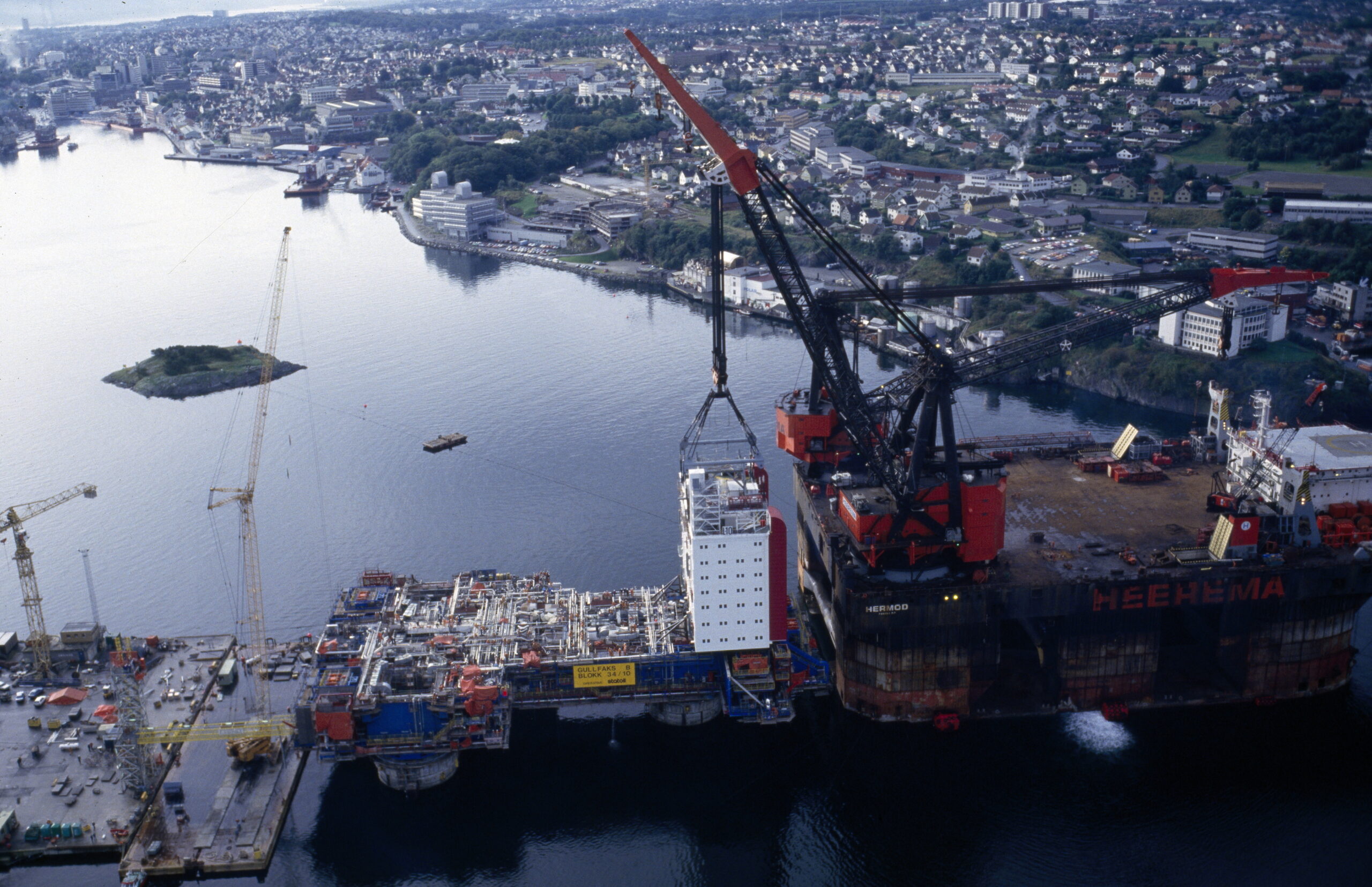
Arve Johnsen saw modularization as a way to strengthen the Norwegian supplier industry. Statoil had pushed for this approach during the Statfjord project and, unsurprisingly, used the same strategy when acting as the operator for Gullfaks A. Breaking the project into smaller contracts made it possible for Norwegian yards and workshops to take on more of the work.[REMOVE]Fotnote: Thomassen, E. (2022). Statoil og Equinor – 1: Middel og mål: 1972–2001 (s. 143).
Many of the contracts for Gullfaks A deck modules were signed during the summer of 1983. Just before the summer holiday that year, contracts worth NOK 250 million were awarded.[REMOVE]Fotnote: Status: internavis for Statoil-ansatte. (1983). Nr. 12. s. 2.
Module contracts for the Gullfaks A deck
| What | Number | Who | Where |
| Living quarters | L11, L12, L13 | Leirvik Sveis | Stord |
| Emergency generator module | M21 | Nordoffshore | Sandnessjøen |
| Flare boom | M26, M27 | Nordoffshore | Sandnessjøen |
| Power station module | M22 | Kværner Brug | Egersund |
| Control and switchgear rooms | M11, M12 | Aker Verdal | Verdal |
| Water injection and process support | M13, M23 | Sterkoder | Kristiansund |
| Compressor module | M24 | Aker Verdal | Verdal |
| Gas processing module | M14 | Horten Verft | Horten |
| Separation modules | M15, M25 | De Groot | Netherlands |
| Wellhead modules | M16, M17 | Belleli | Italy |
| Drilling tower, substructure, and pipe storage | – | Moss Rosenberg Verft | Stavanger |
| Drilling module | D11 | Bergen Mekaniske | Bergen |
| Helideck, elevator, and hangar | – | Oil Industry Services | Kristiansand |
| Gas turbines and separator | – | Kværner Brug | Oslo |
📷 Caption: The table shows who built the different Gullfaks A deck modules and where they were constructed.
(Source: Status: internal newspaper for Statoil employees, 1983, No. 16, p. 10.)
Two international companies were awarded major contracts: the Dutch company De Groot was responsible for building the separation modules (M25 and M15), while the Italian company Belleli built the two wellhead modules (M16 and M17).

Module lifting and final assembly
Once the deck frame was launched and placed on temporary concrete legs on February 22, 1985, module lifting could begin. Lifting and integration of the modules continued throughout the year.
This marked the beginning of a new phase, requiring a significant increase in manpower. The influx of workers exceeded the available housing capacity, so, in agreement with local authorities, many workers were housed in temporary barracks and even in buildings still under construction.[REMOVE]Fotnote: Status: internavis for Statoil-ansatte. (1984). Nr. 18.s. 15.
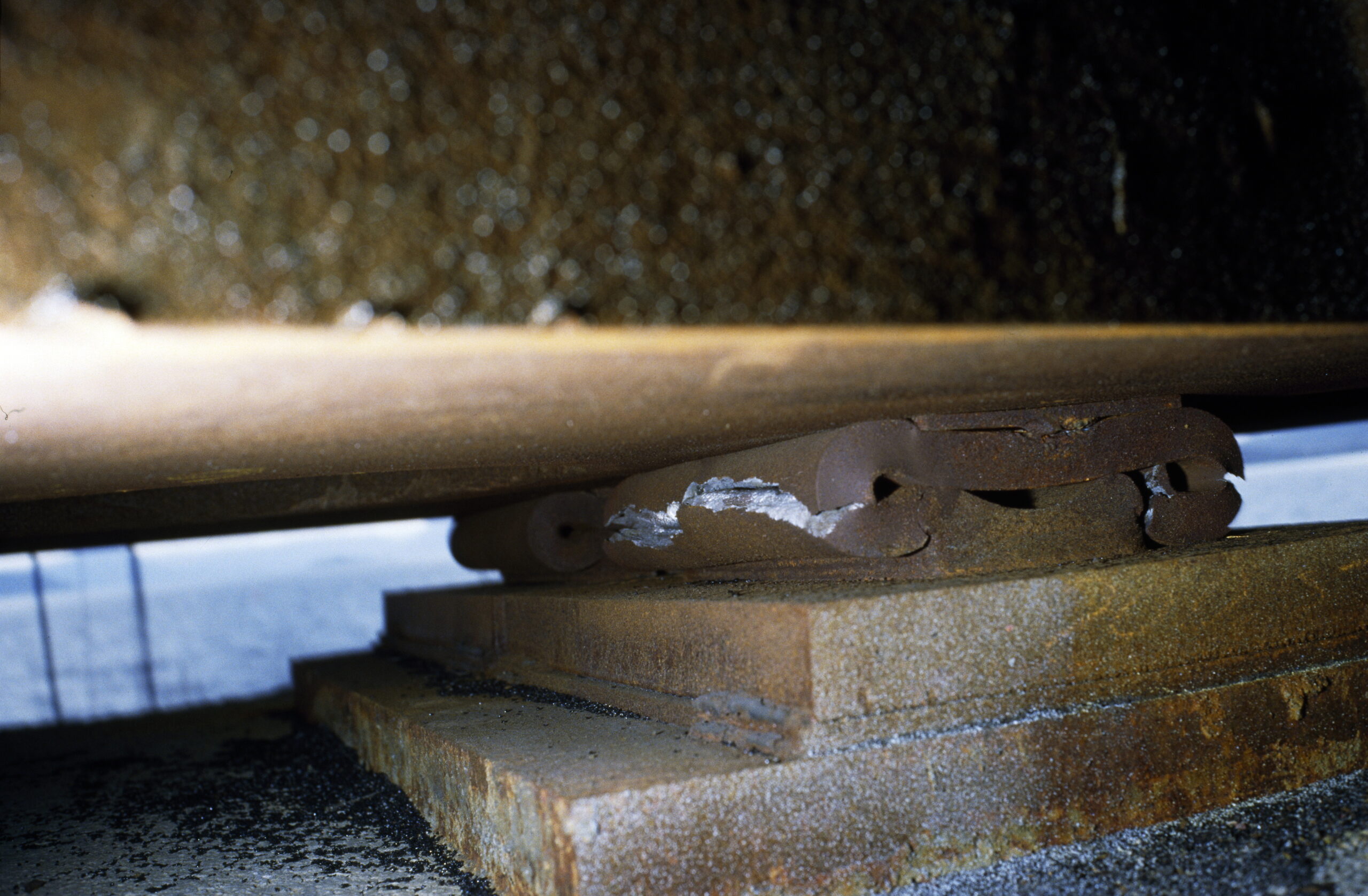
The work generally proceeded smoothly, but in the final stages of construction, on November 7, 1985, a miscalculation caused a critical issue. The weight load on the seawater shaft, located beneath the living quarters on the platform’s western side, was too high. The “shock absorbers” between the deck and the concrete structure (crush tubes) had buckled under the pressure, shifting an excessive portion of the deck’s weight onto one of the concrete legs.
After a few days, the deck was lifted, and steel plates were inserted between the deck and the concrete legs to redistribute the weight evenly. There was never any danger to personnel, but all work was halted until the issue was resolved.
By the turn of the year 1985/1986, the deck was ready for departure from Stord. The journey continued to Digernessundet, where it was mated with the concrete substructure. Statoil had initially planned for Aker Stord to handle the deck-to-substructure connection as an extension of their deck construction contract. However, this work was awarded to Norwegian Contractors, the company that had built the concrete substructure.[REMOVE]Fotnote: Stavanger Aftenblad (1983, 3. februar). Vellykket Gullfaks-kobling. s. 22.
From Statoil to the StateSaved by the B deck?