
“In training”

-There’s more wrench work here than on newer platforms, says process operator Anette Kristin Darre Øberg about working on Gullfaks A.[REMOVE]Fotnote: Anette Kristin Darre Øberg (Process Technician), in conversation with Ole Kvadsheim, Shadé B. Martins, and Julia Stangeland, Gullfaks A, June 25, 2024. While the newer platforms are more modern, Gullfaks A, B, and C were built in a period when a good number of processes were still manual.
In addition to the fact that the “old ladies”- the older platforms – need more maintenance and were designed for a different way of working, the large platforms on the Gullfaks field, especially A and C, offer rich opportunities for high‑volume practice in medical care, helicopter operations, and crane work, as well as in wells and drilling.
Apprenticeships and training have a strong position on the Gullfaks field, as they do elsewhere in the company.
Statoil/Equinor Apprentices
Statoil was approved as a training company in 1980. The very first apprentice learned the craft of typography at Statoil’s in‑house print shop.[REMOVE]Fotnote: “Statoil godkjent som lærebedrift. Inger S. Ravnestad trykkeriets første typograflærling,” Status 7, no. 19 (1980): 5.
Typography has long since become history, but Equinor still takes in apprentices. Around 150 people receive training at Equinor each year.[REMOVE]Fotnote: According to Statoil/Equinor’s annual reports, the company had an average of 146 apprentices between 2013 and 2019. In recent years, the company has not reported the number of apprentices in its annual reports. The service and administration trades and IT are perhaps the closest equivalents to typography today. Outside the offices, Equinor offers apprenticeships in automation, industrial mechanics, chemical processing and laboratory science, the crane and lifting operations trade, and logistics. Culinary apprentices can also train at Equinor.[REMOVE]Fotnote: “Fagområder for lærlinger,” Equinor, https://www.equinor.com/no/karriere/fagomrader-for-laerlinger, accessed September 2, 2024.
Some of these apprenticeships are at Equinor’s onshore plants, notably Mongstad and Kårstø, while others are offshore.
Recruitment Needs
The research institute NORCE has assessed that a large number of offshore employees will need to be replaced in the years ahead. The greatest hiring need is for people with a trade certificate. Between now and 2028, the annual need is estimated at 250–300 replacements with trade certificates.[REMOVE]Fotnote: Øystein M. Fjelldal and Atle Blomgren (both NORCE), Offshoreansatte 2018–2023, Report no. 23-2023, Helse og Samfunn, 50, https://norceresearch.brage.unit.no/norceresearch-xmlui/bitstream/handle/11250/3120611/NORCE%20H%26S%20rapport%20nr.%2023-2023.pdf?sequence=1&isAllowed=y, accessed August 1, 2024.
NORCE also notes in the same report that roughly 30 percent of offshore workers are employed by the operating company, while the rest work in companies that handle, for example, drilling, rig operations, maintenance, or subsea technology.[REMOVE]Fotnote: Fjelldal and Blomgren, Offshoreansatte 2018–2023, 3 and 13.
In addition to apprenticeships with the operator, it is also possible to be an apprentice offshore with a contractor. Some of those apprentices will do their training onshore and not come offshore until they are fully qualified, but especially in wells and drilling it is natural for all or part of the apprenticeship to take place offshore. According to the Training Office for Offshore Trades, since 1999 there have been 3,308 apprentices in drilling, well services, remotely operated subsea operations, and the crane trade who have done their apprenticeship on an offshore installation. Not all of these were under Equinor.[REMOVE]Fotnote: Email from Hanne Grethe Kvamsø (Managing Director, Opplæringskontoret for Offshorefag, OOF) to Julia Stangeland, August 5, 2024.
As with wells and drilling, the best way to learn a process plant is to be where the plant actually is. Those who do not get an onshore apprenticeship may, for example, end up training on the Gullfaks field.
Learning Over Time
-Two years sounds like a long time, but it isn’t. You really have to stay sharp out here, and you need to repeat things when you’re home — sketch, review, and say things out loud to yourself. It’s going to be hard if you don’t, process operator Ole Johan Sverdrup told his apprentice, Ingelill Johansen Handeland, during her first offshore trip around 2005.[REMOVE]Fotnote:NRK, Oljeriket, 2005, approx. 20 minutes into episode 5, https://tv.nrk.no/serie/oljeriket/sesong/1/episode/PRHO97000504, accessed September 3, 2024.
Sverdrup was pointing out that the offshore rotation keeps interrupting the flow of training. Given time, though, it works out.
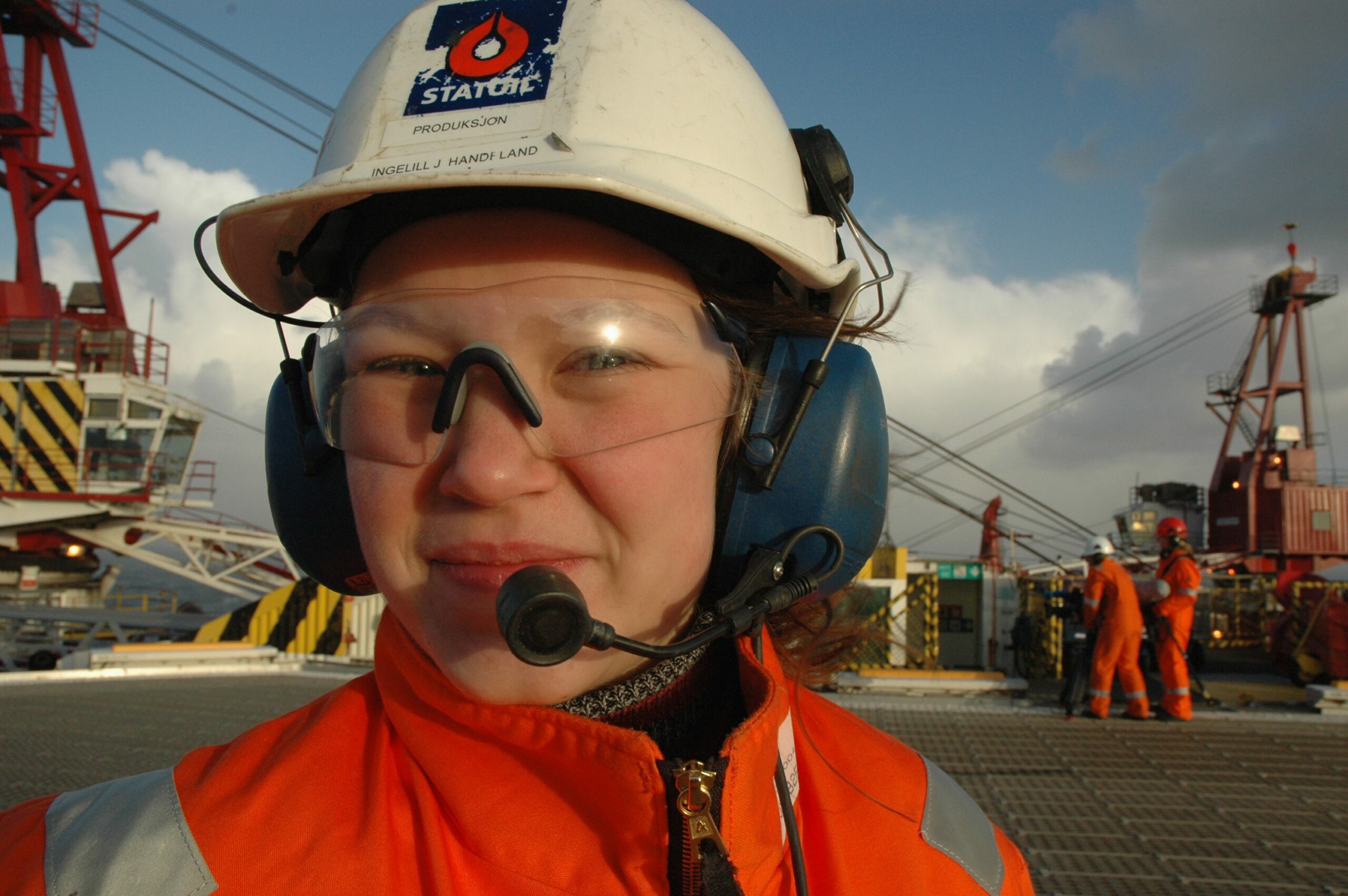
-It was really difficult in the beginning. Then everything was just a blur and I was properly confused, but now it’s getting better and better, Johansen Handeland said almost a year after she started as an apprentice.[REMOVE]Fotnote:NRK, Oljeriket, 2005, approx. 15 minutes into episode 7, https://tv.nrk.no/serie/oljeriket/sesong/1/episode/PRHO97000504, accessed September 3, 2024.
Maybe she shared some of the feelings apprentice Ellen-Anna Øverleir felt when she first began her apprenticeship at Mognstad. She could not tell properly what was what in the process plant, it was all just pipes.[REMOVE]Fotnote: Status, 2006, no. 6, “Klekker ut operatører,” 16–17.
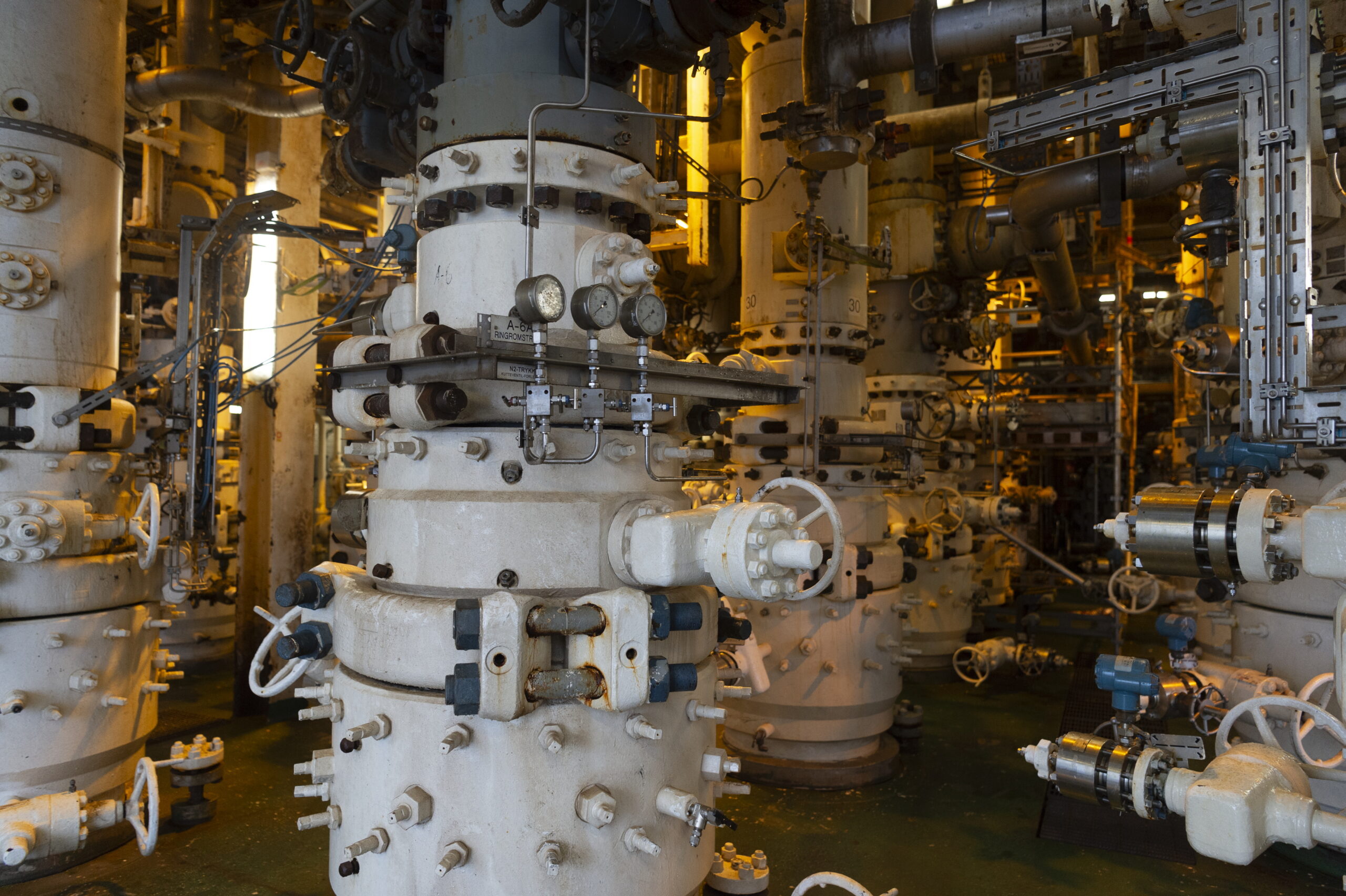
As process operator Anette Kristin Darre Øberg put it at the start, the Gullfaks platforms are, in her view, a good place to learn. On the older platforms, apprentices can build a solid foundation that prepares them to work on both older and newer installations later.
Logistics work is not straightforward on Gullfaks either. Whereas installations like Johan Castberg were designed so a forklift can easily move containers from the supply deck to different areas, that is not the case on the Gullfaks platforms. Here the containers have to be moved by one of the four cranes. That, together with the sheer volume of supplies, gives crane‑operator apprentices a lot of reps.
Repetition also matters in other forms of training and specialization.
High‑Volume Practice
– New offshore nurses are often assigned to the largest platforms. That’s where the most people are and thus where there are great opportunities for high‑volume practice, says nurse Anne Marthe Våge Djønne on the Gullfaks A platform.[REMOVE]Fotnote:Anne Marthe Våge Djønne (Nurse), in conversation with Shadé B. Martins, Ole Kvadsheim, and Julia Stangeland, Gullfaks A, June 26, 2024.
Even though offshore nurses are fully qualified when they come aboard, it is easier to feel confident in the new workday on the larger installations.
The high headcount on board at any given time—especially on the big platforms Gullfaks A and C—also means more helicopter movements and many chances to practise receiving helicopters and new crews and sending them off again, says Helicopter Landing Officer (HLO) Tor Gunnar “Tolle” Groven. He adds that this is why Gullfaks A is often used to train new HLOs.[REMOVE]Fotnote: Tor Gunnar “Tolle” Groven (HLO), in conversation with Shadé B. Martins, Ole Kvadsheim, and Julia Stangeland, Gullfaks A, June 26, 2024.
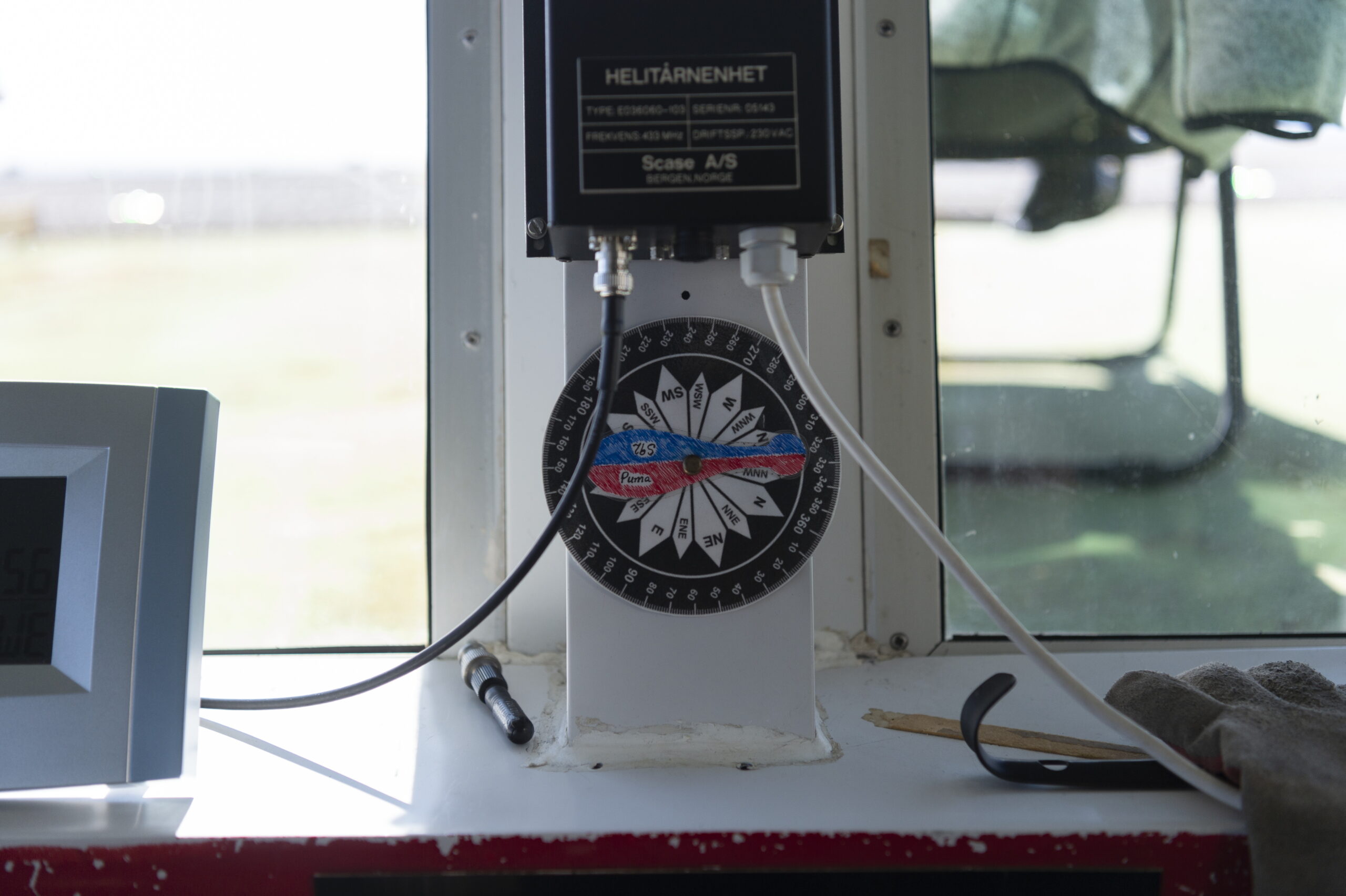
After two years “in training,” apprentices will, hopefully, have carried out most of the tasks tied to their trade, observed and practised, and be ready to sit their trade certificate exam. Some then go ashore; others stay offshore, on the Gullfaks field or on other oil and/or gas fields.