
From Fjord You Came…

Industrial sites along the fjords of Western Norway have, throughout the oil
age, built and completed many of the petroleum installations on the Norwegian
and UK continental shelves. Key examples include Norwegian Contractors in
Hinnavågen near Stavanger, Aker Solutions at Stord, and, to some extent,
Åndalsnes in the northwest.
Similarly, several other places have specialized in supply and maintenance
during the operations phase: Vestbase (Kristiansund), Mongstad (Nordhordland),
Polarbase (Hammerfest), Helgelandsbase (Sandnessjøen), Florø, Ågotnes
(Øygarden), and Dusavik (Stavanger).
On judgment day—that is, when the licensees decide to shut down and remove the installations—the question is where they will be cut up and recycled. In
Norway there are two major players in this space: Aker Solutions at Stord and
AF Gruppen in Vats.[REMOVE]Fotnote: There are also smaller facilities, such as Lutelandet in Vestland county and Lyngdal in Agder, but these have far less regularity in the volume of assignments. See page 20 in: Østring, Peder R. 2022. From Rigs to Riches. A case Study of Oil and Gas Decommissioning in the North Sea through a Just Transitions Framework. Master thesis (human geography), 2022, UiO.
Aker Solutions
Aker Solutions is the largest offshore yard in Norway. Its roots go far back,
and the yard has been known under several names. It began with a herring‑oil
plant more than 100 years ago. After the Second World War it focused on
shipbuilding, while from the 1970s oil‑related work became the mainstay—such
as platform topsides and production and storage ships. Perhaps best known is
the yard’s role in building the topsides for Gullfaks A and C, as well as
Statfjord A and Troll A.[REMOVE]Fotnote: Myklebust, Alf Terje 1994. 75 år på Kjøtteinen 1919–1994. Jubileumsbok for Aker Stord. Stord: Aker Stord, s. 209–210.
Running a yard and running a fairground have one thing in common: you have to
cope with rollercoasters. For a yard this is true in an economic sense—you are
always vulnerable to gaps in the order book.
Decommissioning and scrapping assignments therefore became a welcome second leg to stand on when newbuild projects dried up.[REMOVE]Fotnote: See Østring 2022, p. 65. In one sense Aker Solutions had an advantage: intimate knowledge of the construction of several installations now slated for removal.[REMOVE]Fotnote: Among recent assignments it may be mentioned that in May 2023 Aker Solutions was given the task of recycling the steel jackets for Ekofisk 2/4 G and Heather A (Energi24.no: To nye Decom-oppdrag til Aker Solutions).
https://energi24.no/nyheter/to-nye-decom-oppdrag-til-aker-solutions
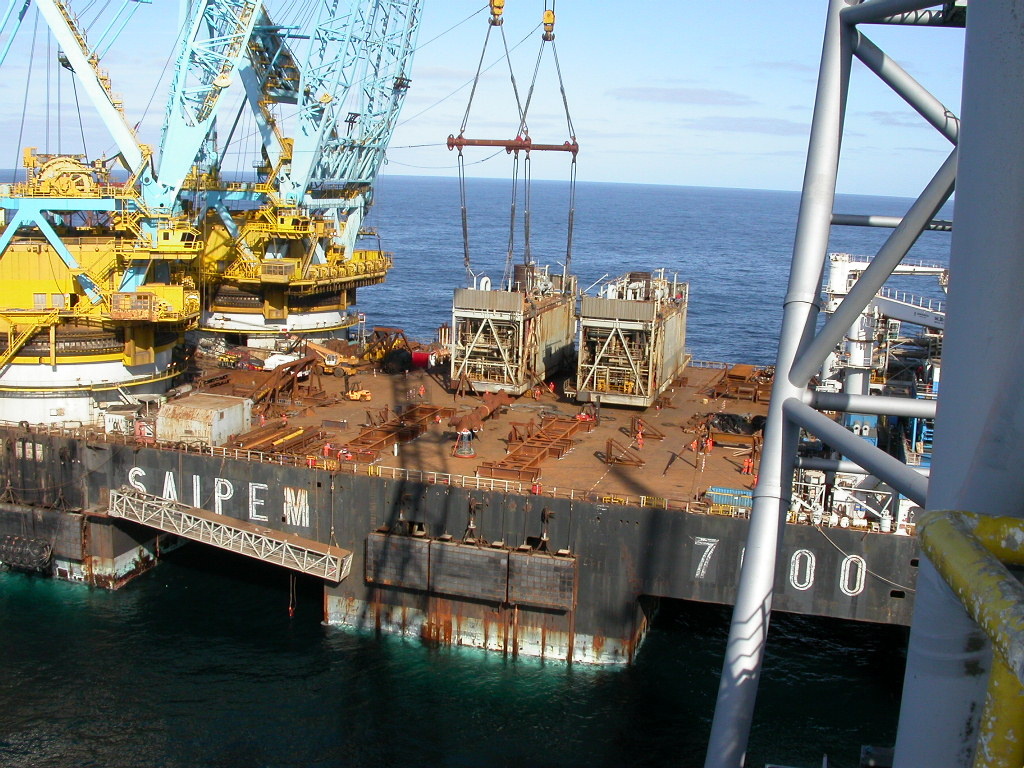
At Stord there was—and is—a strong desire for predictability about when
installations will be retired, so that a larger permanent workforce can be
built up at the yard.[REMOVE]Fotnote: Østring 2022, p. 102. In that respect, repeated postponements of field
shut‑downs pose a challenge for the dismantling industry.
One reason for the delays is that changing oil and gas prices alter the
profitability picture for operators and license partners. Neither high nor low
prices are, as human geographer Peder R. Østring sums it up, favourable for the
industry that lives off receiving obsolete installations:
“Briefly put, when prices are low companies might face a liquidity squeeze and
not afford to undertake decommissioning, while high prices incentivises
prioritizing investments in further extraction, with the result of the date of
the decommissioning being extended in both scenarios, albeit by different
mechanisms.”[REMOVE]Fotnote: Østring 2022, p. 101.
Seen this way, from Aker Solutions’ standpoint, it would be desirable to have
policy signals with a broader industrial‑policy perspective than a sole focus
on the oil companies’ bottom lines.
AF Miljøbase Vats
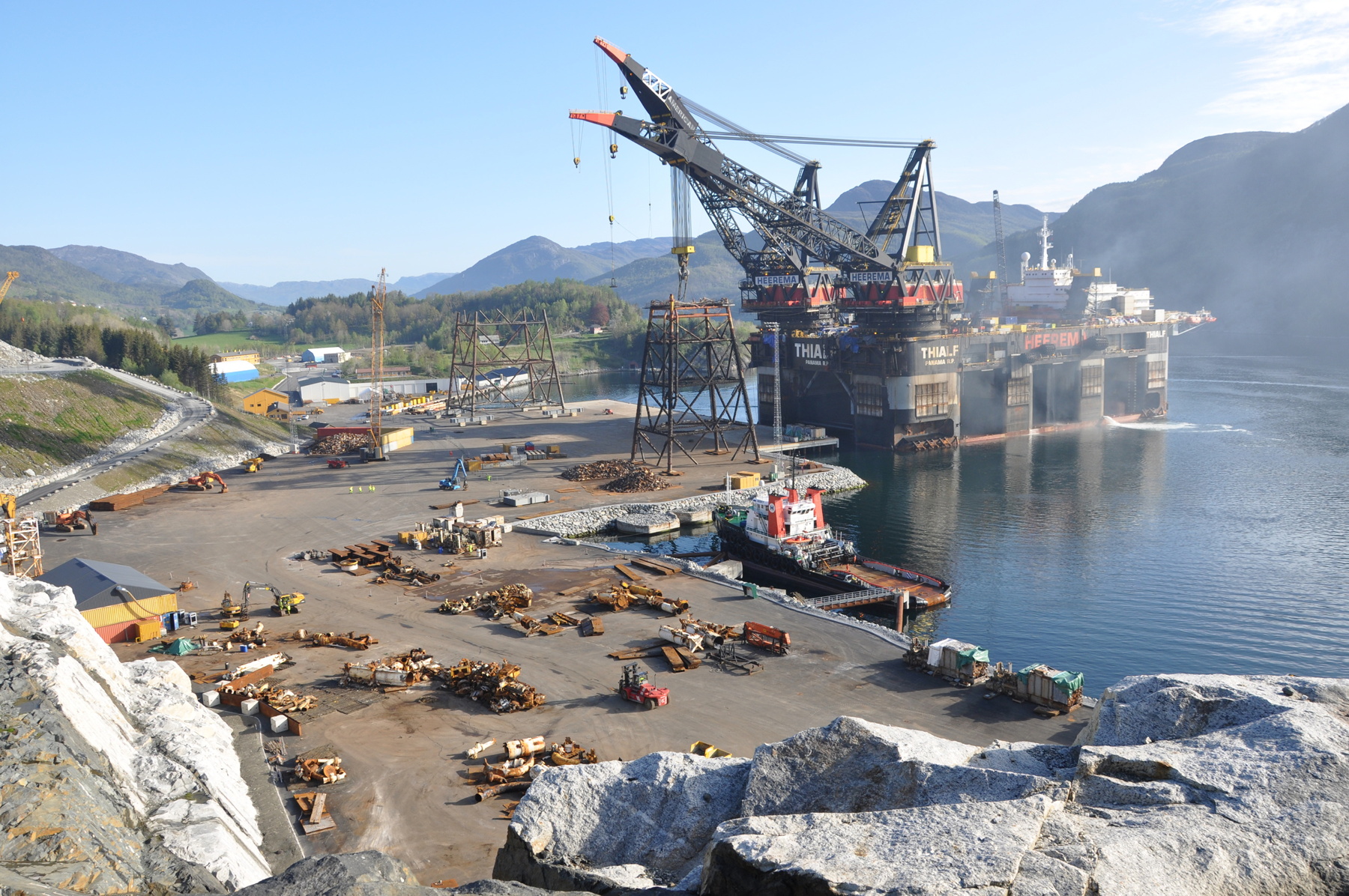
AF Miljøbase in Vats is the largest player in Norway within dismantling and
recycling of offshore installations.
AF Miljøbase is part of AF Gruppen, a major company in the construction and
civil‑engineering sector.[REMOVE]Fotnote: https://www.afgruppen.no/ Since 2005 the industrial group has expanded by developing an industrial area at Raudnes in Vats. This is the same area that in the 1980s and 1990s was used for the construction and assembly of several of the large concrete platforms, including much of the Gullfaks C substructure.[REMOVE]Fotnote: See also articles on Vats.
There is no doubt that the demolition phase employs significantly fewer people
than the construction phase. While Vats, in the most intense building periods,
could employ 2,000–3,000 people, dismantling the topsides of the British
Murchison installation employed around 45.[REMOVE]Fotnote: Østring 2022, p. 63.
There is also some frustration at AF about unpredictability and large
variations in workload from season to season. In 2021 project director Ricky
Rittmar put it this way: “I mean, in 2019 we produced about 30 000 tonnes at
the base, roughly, the same in 2020. This year we had 60 000 tonnes. The next
year over 50 000. Then it is expected to be significantly lower in ’23 and ’24,
before the workload is expected to pick up significantly again”.[REMOVE]Fotnote: Interview with R. Ryttmar, in: Østring 2022, p. 100.
Aker Solutions and AF Gruppen in 2021 explored whether to merge their
respective dismantling and recycling businesses. This was subsequently
shelved.[REMOVE]Fotnote: AF Gruppen 2021. AF Gruppen og Aker Solutions går sammen om å skape et globalt offshore resirkulerings- og dekommisjoneringsselskap.
https://www.afgruppen.no/nyheter/2021/07/af-gruppen-og-aker-solutions-gar-sammen-om-a-skape-et-ledende-globalt-offshore-resirkulerings–og-dekommisjoneringsselskap/ AF Gruppen 2021. Prosess med Aker Solutions er avsluttet.
https://www.afgruppen.no/nyheter/2021/12/prosess-med-aker-solutions-er-avsluttet/
Gullfaks
The Gullfaks platforms follow the trend of extended lifetimes: In March 2019
Equinor obtained approval to extend the lifetime of eight installations,
including Gullfaks A, B and C. All the platforms on Gullfaks will thus, in
principle, produce until 2036. For each of the three platforms this represents
extensions of 20 years (A’s original lifetime ran to 2016), 19 years (B’s to
2017) and 17 years (C’s to 2019).[REMOVE]Fotnote: Equinor 2019. Forlenger levetiden for åtte installasjoner.
https://www.equinor.com/no/news/archive/2019-03-14-extending-life-ncs
The main arguments from Equinor and Arne Sigve Nylund, executive vice
president for Development and Production Norway, were that such a life
extension represented “very sound resource management,” and that it secured
many jobs offshore, onshore in administration, and among suppliers. But it also
creates a measure of unpredictability for the dismantling and recycling
industry.[REMOVE]Fotnote: Equinor 2019. Forlenger levetiden for åtte installasjoner.
https://www.equinor.com/no/news/archive/2019-03-14-extending-life-ncs
Where the Gullfaks platforms ultimately end up—at Stord, in Vats, or somewhere
else—remains an open question. There is little doubt, however, that the fjord
landscape will increasingly frame not only the start but also the end of the
installations’ life cycles.
It also remains to be seen whether some of them, wholly or partly, will be left
in place on the shelf as industrial heritage.