
Disaster in Gandsfjorden: The Concem Incident

The barge was used to produce concrete for the slipforming of the cells on Gullfaks B. Concem was equipped with two concrete mixing plants and served as a storage facility for cement and other materials needed for concrete production.
Background
The Concem barge was assembled from parts of different ships. The hull was originally the bow of the M/S Belblue, a vessel capable of transporting ore, bulk, and oil. It was built in Germany in 1968. After changing ownership several times, the ship was purchased in 1992 by a shipping company in Oslo, which later sold it to Norwegian Contractors (NC).
NC needed a platform to produce mortar and concrete for its construction projects and commissioned Framnes Mechanical Workshop to convert the bow into a barge. Concem was delivered to NC in November 1983.
The barge was intended to serve as a base for machinery to produce a special mortar for use in the North Sea, as well as equipment for producing concrete for platform foundations in Gandsfjorden near Stavanger. A mortar mixing plant was installed at the front of the barge, and two concrete stations and silos for sand and gravel were set up on the deck.[REMOVE]Fotnote: Report from the Commission of Inquiry regarding the capsizing of the barge “Concem” on November 4, 1985. Submitted on December 16, 1985 by Olav T. Laake (Chair), Nils Elster, and Emil Aall Dahle. Rapport fra undersøkelseskommisjonen i anledning lekteren “Concem”‘s forlis den 4. november 1985
The first assignment was on Statfjord C, where the barge was used to spray mortar beneath concrete structures to prevent seabed erosion—a process known as grouting.
In the fall of 1984, Concem was brought ashore to install foundations and equipment for concrete production. On October 22, 1985, the barge was moored to Gullfaks B, which was under construction in Hinnavågen. Concem was now to be used to produce concrete for this project.
The Night of the Accident
The Gullfaks B platform was moored in Hinnavågen in Gandsfjorden, where around a thousand workers were engaged in casting the 19 cells that would form the concrete substructure. Most of the workers were temporary employees, and the project was about halfway completed when the accident occurred. Approximately ten days of casting work remained.
On November 4, the evening shift, which lasted from 3 PM to 11 PM, consisted of about 200 people. Twenty-two of them were on board the Concem barge. Concrete production was ongoing. At the same time, cement was being loaded into both the aft port-side hold and the forward starboard-side hold, while cement was also being discharged from the same holds. In the aft hold, cement had accumulated in larger quantities on the port side, while there was less on the starboard side. A crater had formed in front of the area where cement was discharged through bottom sluices.
To facilitate the flow of cement, air was blown under the panels at the bottom of the hold. This made the cement more fluid, allowing it to be directed into the sluices. The barge had a list of four degrees to starboard, toward Gullfaks B—considered normal. The ballast tanks were half full, a condition seafarers refer to as ‘slack.’
The accident occurred at 8:50 PM. While the operator was blowing air under the panels, the list gradually increased. The cement on the panel became watery, and suddenly a wave of cement shifted from starboard to port in the hold. Approximately 200 tons of cement moved, but the shift was almost silent.
What followed happened very quickly. The barge heeled sharply to starboard and capsized completely within five to ten seconds. Only the bottom remained visible above the water. Containers beneath the main deck and the concrete mixing plant sank to the bottom, about 240 meters deep.
Rescue Operation
Rescue efforts began immediately after the accident, and the search for survivors continued throughout the night. A Sea King helicopter from the rescue service participated in the operation, along with about ten vessels. Several people were pulled from the water, while others managed to climb aboard Gullfaks B on their own.
Early in the morning of November 5, the barge was towed to Hinnavågen, where divers cut holes in the hull to search for survivors or victims. That same evening, one of the deceased was found in a control room.
The diving vessel Arctic Seal arrived to assist with the search. On board were both remotely operated vehicles (ROVs) and experienced divers. However, the operation was severely hampered by strong currents, oil spills, and eventually a full storm with hurricane-force gusts. Loose objects and difficult seabed conditions also posed significant risks to the divers.
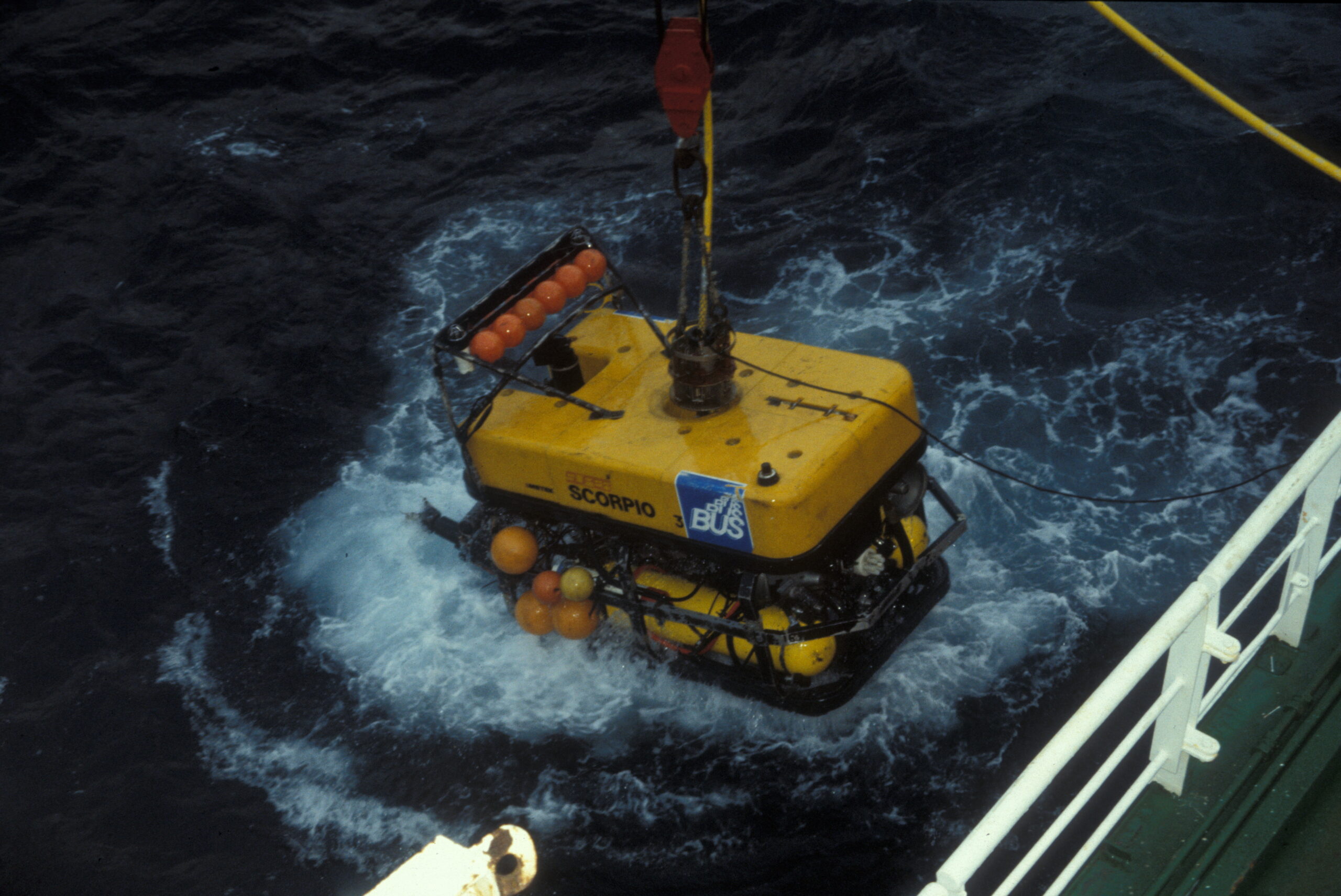
Four British specialist divers were brought in from Aberdeen, equipped with two atmospheric diving suits of the Wasp type. These suits could operate at depths of up to 610 meters and were maneuvered using small thrusters.
The search on the seabed was hindered by clouds of mud stirred up whenever the suits came too close to the bottom. Nevertheless, the search continued for 13 days. Eight of the missing were found and recovered. The last two were never located.
On March 26, 1986, Concem was scuttled in Nedstrandsfjorden—the same location where the Alexander L. Kielland platform had been scuttled two and a half years earlier.
Investigation
A commission of inquiry led by District Court Judge Olav T. Laake was appointed to investigate the accident. The commission concluded that the cause was a combination of human error, technical issues, and unclear regulations.[REMOVE]Fotnote: Report from the Commission of Inquiry regarding the capsizing of the barge “Concem” on November 4, 1985. Submitted on December 16, 1985 by Olav T. Laake (Chair), Nils Elster, and Emil Aall Dahle. Rapport fra undersøkelseskommisjonen i anledning lekteren “Concem”‘s forlis den 4. november 1985
The four-degree list was considered normal but contributed to reduced stability. In addition, several ballast tanks were partially filled—a condition known as ‘slack’—which further weakened the vessel’s stability. The three main causes of the capsizing were:
None of these factors alone would necessarily have caused the accident, but together they led to the barge capsizing within seconds.
The commission also pointed out serious deficiencies in the training of operators handling the ballast and cement systems. There were no clear instructions for safe operation, and the training was haphazard and inadequate. A better regulatory framework for barge staffing could, according to the commission, have prevented the accident.
The lack of clear regulations was already known before the accident. In 1982, the Norwegian Maritime Directorate had submitted a comprehensive report highlighting major ambiguities related to the staffing and operation of so-called unmanned barges. However, the report did not lead to concrete measures.
The commission also believed that the accident could have been avoided if personnel with maritime education had been on board. Concem should have been classified as a manned barge, which would have triggered requirements for qualified crew. In practice, the barge was never unmanned—there were always people on board—but they were not formally signed on and therefore had no responsibility for navigation, maintenance, or safety procedures.[REMOVE]
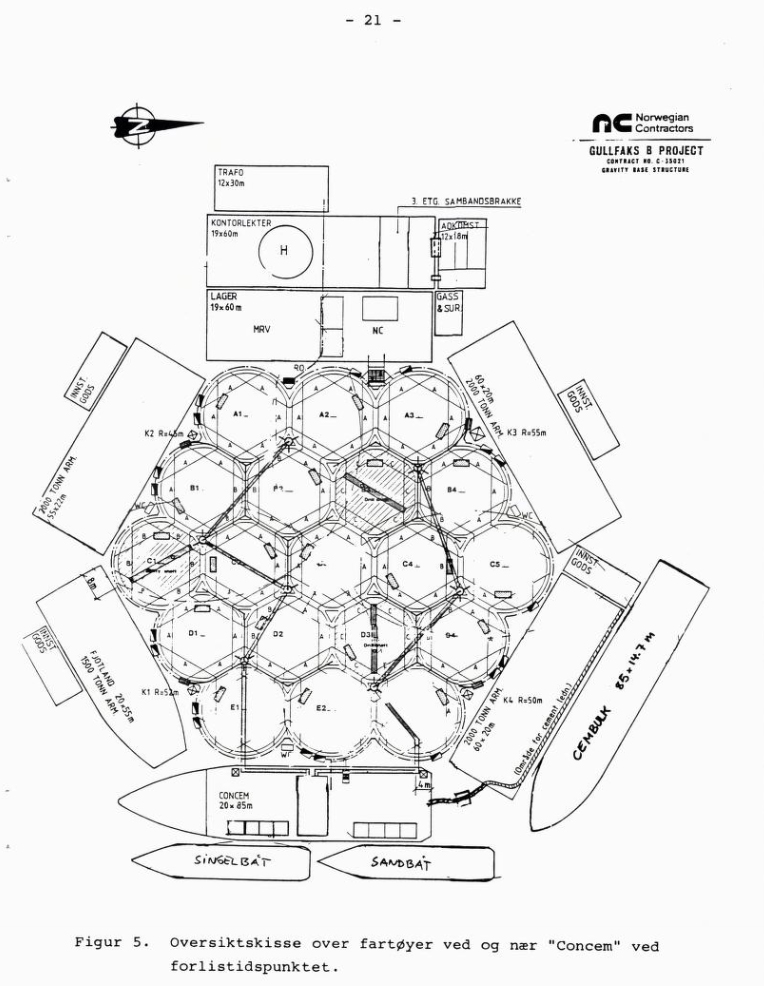
Fotnote: Stavanger Aftenblad. (1986, 11. januar). Ulykken kunne vært unngått.
Aftermath
The police investigated the accident and fined Norwegian Contractors NOK 1.5 million for violations of the Working Environment Act.[REMOVE]Fotnote: Stavanger Aftenblad (1987, 26. januar). NC vedtar concem-bot. The company was accused of neglecting its responsibility for training and safety of the crew on board Concem.
In 1992, a simple memorial was erected in Hinnavågen, overlooking Gandsfjorden—the site of the accident.
Gullfaks B slipform haltedThe A deck and substructure meet