
Gullfaks and Gullfakse

The name Gullfaks can be traced back to two sources: Gullfakse, the horse from Norse mythology, and the ship Gullfaks, which could travel as swiftly on land as on water, as described in Norwegian folk tales collected by Asbjørnsen and Moe.[REMOVE]Fotnote: Statoil. (1990, november). Gullfaks – glimt fra historien om et helnorsk oljefelt. Den norske stats oljeselskap a.s. Stavanger. Side 18 og 31. https://www.nb.no/items/4f4ceb82f9be24c64834e1a04a0a7ca1?page=0&searchText=helnorsk
Likely, both origins influenced the choice of the name for the field. This article focuses on the Norse interpretation.
Norse names have been a recurring trend in Norway’s oil history, with a marked increase in the early 1980s. In the five years leading up to the approval of the first plan for development and operation (PDO) for Gullfaks in 1981, over 70% of field names were derived from Norse mythology. The name Gullfaks reflects this era.
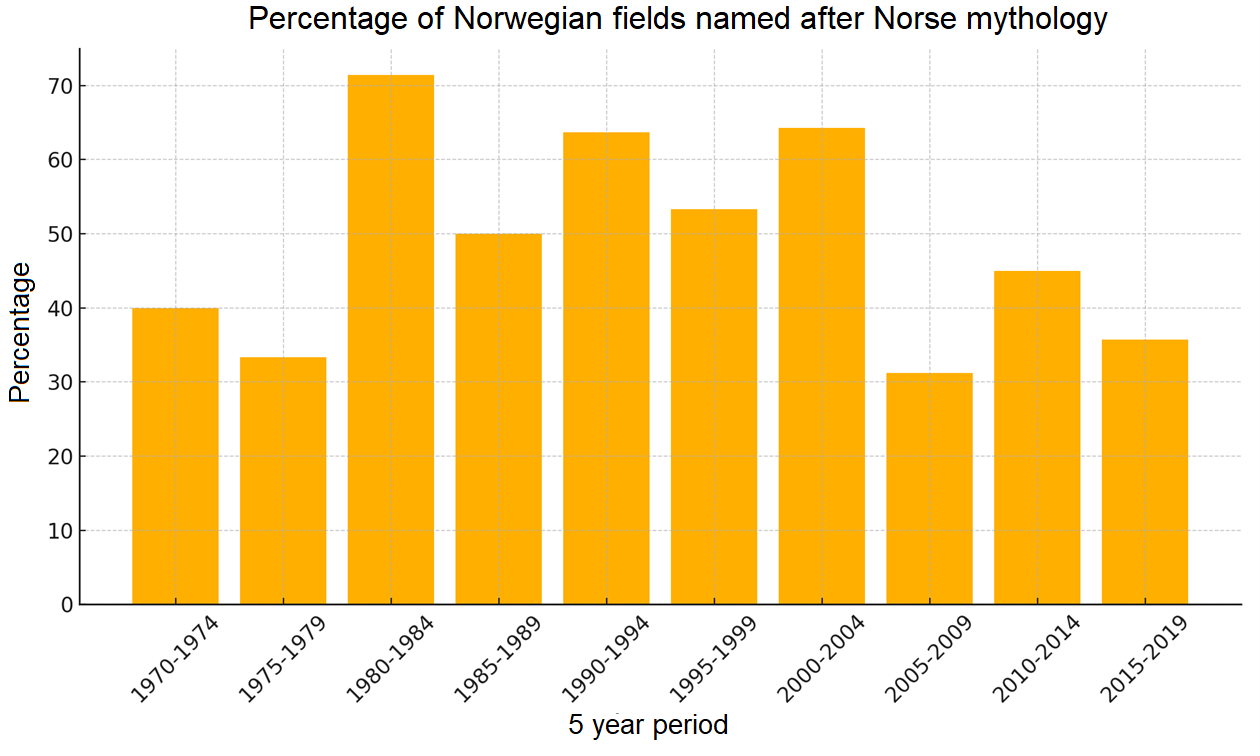
On May 2, 1982, Statoil announced that the Norwegian Language Council had approved “Gullfaks” as the name for block 34/10. The Ministry of Petroleum and Energy had also indicated that they had no objections to the name.[REMOVE]Fotnote: Bergen Nytt. (1982, mai). 34/10 Prosjekt nytt. Bergen Nytt, 1(2).Before that, the area was referred to as “Gullblokken” or simply by its block number, 34/10. In the Norse context, Gullfaks refers to “the horse with a golden mane,” known as Gullfakse in Snorri’s Edda.[REMOVE]Fotnote: Snorre Sturlason. (n.d.). Tor og Hrungner (Skáldskaparmál, kap. 24–25). Hentet 9. oktober 2024 fra https://heimskringla.no/wiki/Uddrag_af_Snorres_Edda#Sk.C3.A1ldskaparm.C3.A1l
The Story of Gullfakse
The tale begins with Odin riding his eight-legged horse, Sleipnir, into Jotunheim, the land of the jotnar (giants). There, he encounters the jotun Hrungnir, who notices Sleipnir and boasts about his own horse, Gullfakse, claiming it to be the fastest horse in the world. Hrungnir challenges Odin to a race from Jotunheim to Asgard.
Odin sets off, and Hrungnir follows on Gullfakse. Despite the jotun’s speed, he cannot catch Odin and ends up in Asgard, the home of the Norse gods, where he is invited to a feast.
The atmosphere soon turns sour. After heavy drinking, Hrungnir begins boasting and threatening to destroy Asgard, seize Valhalla, and abduct the goddesses Freyja and Sif. The gods tire of his behavior and summon Thor, who confronts Hrungnir. Hrungnir insists it would be cowardly to fight him while he is unarmed and challenges Thor to a duel.
On the day of the duel, Hrungnir arrives with Gullfakse. Thor hurls his hammer, Mjolnir, striking Hrungnir in the head and killing him. As the jotun falls, his leg traps Thor, and none of the gods can free him.
Eventually, Thor’s three-day-old son, Magni, arrives and frees his father. In gratitude, Thor gifts Gullfakse to Magni, angering Odin, who feels the horse should have been given to him instead.
Similarities
It is tempting to draw parallels between the Gullfaks oil field and the horse Gullfakse.
In mythology, Gullfakse is introduced through its race against Odin’s horse, Sleipnir. Similarly, Gullfaks C competed, in a sense, with the Sleipnir gas field. The PDO for Gullfaks C was approved in April 1986. Initially, its development was planned for a later date. However, when a deal with the British for Sleipnir gas collapsed in 1985, it freed up capacity in the supplier market, allowing Gullfaks C to move forward ahead of Sleipnir.
Another parallel is the concept of Gullfakse as a gift. After Thor defeats Hrungnir, he gives the horse to his infant son, Magni, which Odin deems overly generous.
When Gullfaks was approved for development in 1981, Statoil was nearing its 10th anniversary—a relatively young age for an operator. Drawing the analogy further, Statoil can be likened to Magni, while the Norwegian Petroleum Directorate (NPD) parallels Odin.
During the approval process, the NPD argued that Statoil should first operate a smaller field to avoid exceeding the production cap of 90 million tonnes of oil equivalents and to gain valuable experience for larger future projects.
At the official opening of Gullfaks A in 1987, Minister of Petroleum and Energy Arne Øien also linked Gullfaks to Gullfakse. He noted that while Gullfakse was an exceptional horse, it did not fully meet expectations—much like the oil field, which proved more challenging to develop than anticipated. Shallow gas pockets and sand in the oil created complications, making Gullfaks more difficult to manage than initially thought.[REMOVE]Fotnote: Statoil. (1990, november). Gullfaks – glimt fra historien om et helnorsk oljefelt. Den norske stats oljeselskap a.s. Stavanger. Side 18. https://www.nb.no/items/4f4ceb82f9be24c64834e1a04a0a7ca1?page=0&searchText=helnorsk