
Building the C Topside

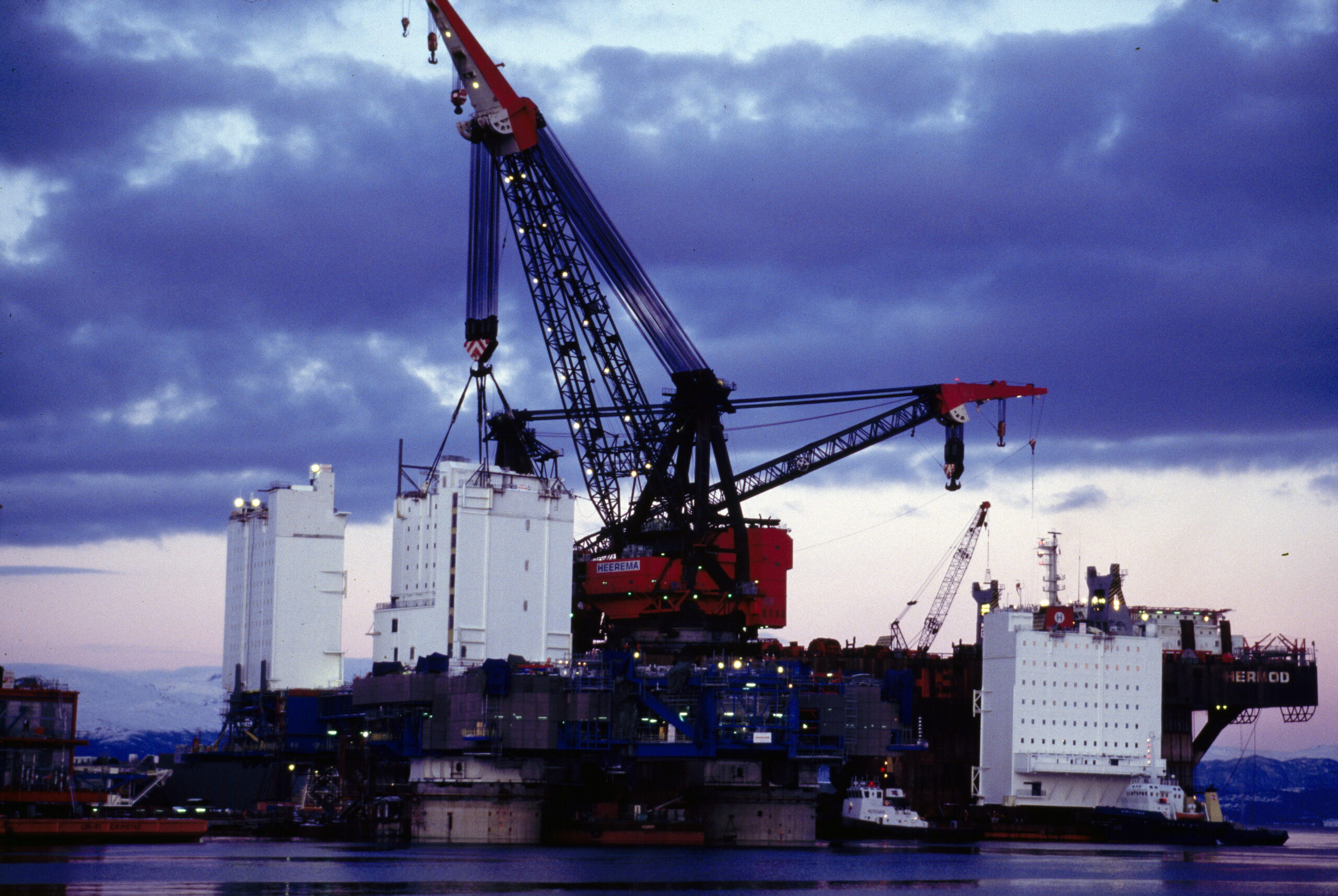
On 5 October 1986, Aker Stord gradually began construction of the deck for Gullfaks C. In February the following year, work started in the dock. The years 1986, 1987 and 1988 were marked by the construction of the C-deck and all the associated modules. The work was carried out in several places around the country, before everything was finally assembled at Stord.
At roughly the same time that Aker Stord received the main contract for the deck of Gullfaks C, the yard was awarded a similar assignment for Oseberg A. This triggered a very hectic period in the yard’s history. At peak, about 2,500 people were accommodated in the area. All conceivable conventional lodging was used, along with a large number of caravans.[REMOVE]Fotnote: Myklebust, Alf Terje (1994). “75 år på Kjøtteinen 1919–1994. Anniversary Book for Aker Stord.” Stord: Aker Stord, pp. 116–117. The yard had previously housed many contract workers as well; during the Statfjord A topsides build, the figure in January 1977 reached 2,719.[REMOVE]Fotnote: Meland, Trude. “The work camps.” In: Industriminne Statfjord.
https://statfjord.industriminne.no/en/2018/04/05/the-work-camps/
Many suppliers
The Aker group was a key player in building the Gullfaks C topsides. A substantial part of the module support frame (MSF) for Gullfaks C was fabricated at Aker Verdal.[REMOVE]Fotnote: Myklebust, Alf Terje (1994). “75 år på Kjøtteinen 1919–1994. Anniversary Book for Aker Stord.” Stord: Aker Stord, p. 129. That yard was also responsible for the control room and power distribution modules. Aker Engineering handled engineering for both the topsides and the individual modules. Aker Elektro carried out electrical installation on the topsides and in the concrete substructure (GBS), while Aker Stord had overall responsibility for fabricating the MSF, assembling the modules, mating topsides and substructure, and offshore hook‑up and completion (HUC).[REMOVE]Fotnote: Norsk oljerevy / Norwegian Oil Review. 1990, Vol. 16, No. 4, p. 31.
Leirvik Sveis delivered the living quarters (LQ), as they also had for the two other Gullfaks platforms and all the Statfjord platforms. [REMOVE]Fotnote: Resser, Tor (2001). “Byen Stord.” Stord: Eige forlag, p. 89.The company received the assignment just before Christmas 1985, and the contract was worth NOK 344 million. As at Aker Stord, this led to an extremely
labor‑intensive period, since in addition to Gullfaks C they also had work on Gullfaks B and Oseberg A. The company also built the substructure for Gullfaks C’s helideck, including stairs/elevator and a waiting room. The helideck itself was fabricated by Oil Industry Services (IOS) in Kristiansand.[REMOVE]Fotnote: Myklebust, A., Leirvik sveis. (1996). “Leirvik sveis 50: Anniversary Book for Leirvik sveis.” Stord: [Leirvik sveis], pp. 123 and 194.
Other suppliers included Kværner Bruk, which delivered the gas turbine package and the compressor module; Kristiansand Mekaniske Verksted built the water‑injection and process support module; Vindholmen Offshore handled the
modules for the drilling derrick, pipe rack and office; and Moss Fredrikstad Verksted fabricated the gas treatment module. Foreign suppliers included Italy’s Belleli, which provided wellhead modules, and the Netherlands’ Grootint, which built the separation module. In addition to the major suppliers, the Gullfaks C project sourced equipment and deliveries from many other companies worldwide.
How similar to the A topsides?
The Gullfaks A and C topsides are in most respects alike (see article on the A topsides). That yielded considerable savings, from calculations and drawings through to practical fabrication. There are, however, some key differences: Gullfaks C stands in deeper water and has longer shafts than A, which increases hydrodynamic loads from currents and waves on the structure. As a result, an extra 3,000 tonnes of steel went into strengthening the MSF. The MSF was also three metres wider and two metres longer than on the A topsides.[REMOVE]Fotnote: “Gullfaks C to Aker Stord” (no author) (12 September 1986). In:
Sunnhordland, 12 September 1986.
A consequence of the similarity to the A topsides was that the man‑hours needed to build the C topsides fell significantly. Thanks to the experience gained from the previous project, fewer people from Statoil [now Equinor] followed the process at Stord.[REMOVE]Fotnote: Hansen, Thorvald Buch et al. (1990). “Gullfaks – Glimpses from the
History of a Fully Norwegian Oil Field.” Stavanger: Statoil, pp. 113–114. A central objective was to complete as much as possible onshore; work offshore on the continental shelf carries far higher costs and increased safety risk.
————————————————–
The table below shows who built many of the key modules for the Gullfaks C topsides. See also the table at the end for a comparison with Gullfaks A. The
lists are not exhaustive.[REMOVE]Fotnote: The tables were prepared by Ole Kvadsheim.
Table 1: Gullfaks C
What Number Who Where
| Living quarters | Leirvik Sveis | Stord | |
| Emergency generator module | |||
| Flare boom | |||
| Power distribution module | Aker Verdal | Verdal | |
| Control room module | Aker Verdal | Verdal | |
| Water injection and process support | Kr. sand mek. verk | Kristiansand | |
| Compressor module | Kværner Bruk | Oslo | |
| Gas treatment package | Moss Fredrikstad Verksted | Østfold | |
| Gas turbine package | Kværner Bruk | Oslo | |
| Separation module | Grootint | Nederland | |
| Wellhead modules | Belleli | Italia | |
| Drilling derrick, pipe rack and office | Vindholmen Offshore | Arendal | |
| Helideck | Oil Industry Services | Kristiansand | |
| Helideck substructure | Leirvik Sveis | Stord | |
| Module support frame | Aker Stord/Aker Verdal | Stord/Verdal | |
| Electrical work, topsides and substructure | Aker Engeneering | ||
| Overall responsibility for topsides fabrication | Aker Stord | Stord |
Table 2: Gullfaks A
| What | Number | Who | Where |
| Living quarters | L11, L12 og L13 | Leirvik Sveis | Stord |
| Emergency generator module | M21 | Nordoffshore | Sandnessjøen |
| Flare boom | M26 og M27 | Nordoffshore | Sandnessjøen |
| Power station module | M22 | Kværner Brug | Egersund |
| Control room and switchgear room | M11 og M12 | Aker Verdal | Verdal |
| Water injection and process support | M13 og M23 | Sterkoder | Kristiansund |
| Compressor module | M24 | Aker Verdal | Verdal |
| Gas treatment module | M14 | Horten Verft | Horten |
| Separation module | M15 og M25 | De Groot | Nederland |
| Wellhead modules | M16 og M17 | Belleli | Italia |
| Derrick, substructure and pipe rack | Moss Rosenberg Verft | Stavanger | |
| Drilling module | D11 | Bergen Mekaniske | Bergen |
| Helideck, elevator and hangar | Oil Industry Services | Kristiansand S | |
| Supply gas turbines and separator | Kværner Brug | Oslo |
The Swedish king inspects GullfaksStart of production on Gullfaks A